Saturday, April 30, 2016

On Starting Seeds and Greenhouses


Another couple of rainy, windy, cold days here in Iowa, so I'm inside again, starting a few last seeds and thinking about the process and how I might improve it. The seedlings in the picture above are the petunias I experimented with growing from seed this winter.

I was feeling spendthrift and lazy just going to the nursery and buying flats of petunias and other annuals already started, so I decided to try starting some petunias from seed in mid-March to see how it went.

I have started seeds before and it's usually worked fairly well -- the vegetable seeds I've started for my husband have been quite easy, and I've also started biennials like wallflowers and perennials like the 150 dianthus that edge my four L-shaped pond garden beds (although those are started in late spring and potted up outside until they are planted out in late summer, so they are different than starting seeds indoors under lights in winter and spring).

I bought a soil blocker this spring and used it for the first time with these petunias, and it worked quite nicely. As you can see in the photo, the petunia plants are coming along fairly well, although I had problems with uneven germination and size of plants.

Petunias are not the easiest plants to start from seed and grow inside -- first, they require at least two months of growing in warm, bright conditions, during which many things can go wrong: damping off (I run a small fan nearby to keep the air moving gently), drying out if you forget to water them or go away for a few days, and probably numerous other maladies that can afflict them. And the seeds are quite tiny, so Burpee's (the ones I found locally, so I didn't have to pay for shipping) are pelletized for easier handling, which is fine with me, but that makes them more expensive, and only half of the 50 seeds (2 packets) that I bought germinated, which is disappointing.

I also have some sweet peas and dahlias started from seeds on the top shelf, as well as some freesias just coming up in the pot below. The lights plug into a timer on the wall, and a small fan is on the floor nearby.


To grow them in my basement, I use florescent lights and a heat mat under the flat, both of which cost money to operate (even independently of their purchase cost). I calculated that the 24 petunia plants that I have managed to grow to this point have cost me more than three times as much, per plant, as buying them already in flower from the the least expensive nursery near me:

Cost of 24 Petunia Plants:

$ 3.00    50 Seeds (2 packets @ $1.50 each, only 24 of which germinated)
$ 2.00    Seed Starting Soil
$ 6.50    Cost of running two 32W light bulbs for 14 hours/day for two months
$ 2.50    Cost of running heat mat for two months
$ 3.00    Cost of running small fan (for all seeds)
$17.00

At the Amish nursery near me, a six-pack of petunias costs only $1.29, so 24 petunia plants costs $5.16, less than a third as much as it cost to raise them myself. Even if all 50 seeds had germinated, it still would have cost $17 for 50 plants, compared to $10.75 for 50 purchased plants, which would still be nearly twice as much. Hmmm!

Now, I know that not all plants take as long to start as petunias, and that there are other reasons to start plants from seeds besides saving money: only a limited selection of plants are available as starts locally, so if I want special varieties, I will have to grow them myself. Also, I'm serious about my hobby of gardening, and there's the argument that I really can't consider myself to be any sort of knowledgeable gardener if I don't know how to successfully propagate plants.

So I still want to be able to grow things from seeds, but I might have to re-evaluate how I do it. Much of the cost in my calculation comes from the long periods of running lights, which I would not have to do if I had a small greenhouse.

A Greenhouse?

Now, greenhouses are very common among British gardeners, who can hardly imagine gardening without one. But they're fairly uncommon here in the US, for several reasons: first, it gets MUCH colder here, so it costs a lot more more to heat a greenhouse in winter. (In England, many places hardly get below 20°F, compared to below 0°F here.) Also, it doesn't get as warm there -- in England, many gardeners grow tomatoes in greenhouses, because they just don't get enough heat to grow them outside. Here, a greenhouse is practically unusable in the hotter months (unless it is to sterilize soil).


Many British gardeners can hardly imagine gardening without one of these. (Hartley Botanic)


But this is more like what I'm eyeing: a 4'x8' lean-to style greenhouse.
(EarthCare Greenhouses)

I've been considering getting a small, relatively inexpensive greenhouse for several years now, but I wasn't sure where I would put it, until a few months ago a place occurred to me: The south side of my garage.

I had tried planting sunflowers and iris there to make it look less ugly, but I have realized that I should just consider it a "utility area" and use it as such. I removed most of the plants last week and will at least put a cold frame or two in this spot.


This area on the south side of my garage will never be pretty, with the gas tank, vinyl siding and tiny, ugly window. But it does get full sun and is relatively protected from wind, as well as being near electrical outlets inside the garage.

The eight-foot-long greenhouse would be just to the left of the gas tank, and the garage window could be replaced with a small insulated door, as the inside framing is already appropriate for that. Opening the garage greenhouse door on cold days would release less heat from inside the greenhouse than an exterior greenhouse door would.

I would probably only use the greenhouse in late fall, to protect tomatoes and herbs from frost, and in early spring, to start seeds. I could run a small portable heater on a thermostat in spring to keep the temperature above 50° or so. There would be a cost of heating the greenhouse (I have calculated using an online greenhouse heating calculator that during the months of March and April it would cost about $25/month to keep it at 50°), but the cost could be averaged over a number of flats being started at one time. Perhaps I wouldn't be able to start warm-season flowers and annuals in there until mid-spring, but cool-season annuals and vegetables would probably do well in there earlier in the year.

Of course, I can buy a hundred flats of petunias for the cost of a greenhouse, even the the inexpensive one I'm considering. Realistically, I will probably never justify the nearly $1,000 it will cost me to set up the greenhouse. But on the other hand, it might be fun to have one, and it might make me a more knowledgeable and experienced gardener (or it might just be a place to sit out of the wind on sunny, cold days, or just end up as a place to store pots, like so many gardeners' greenhouses end up...).

I'd like to ask readers, particularly ones gardening in cold climates, whether you have ever used a greenhouse successfully, and for any tips or recommendations on doing so (or not doing so, if you recommend against it).

Thanks for reading, and I hope your own seed-starting efforts are going well this spring! -Beth


Wednesday, April 27, 2016

The Real Work Begins


Greetings! It's been nearly three weeks since my last post, because I have been Busy with a capital "B". Busy in the gardens, which is what most gardeners are in springtime. But this year I'm even busier than usual, having started a massive amount of work in my garden areas, many of which are undergoing big changes.

However, today is rainy, extremely windy and cold, so I'm taking a break from working outside and can post an update. I don't even know where to start (please forgive the length of this post)....

I'm not sure if others feel an occasional panic when walking around their gardens, but I know I had one the other evening. Several of my borders have serious issues dealing with invasive plants that require the Nuclear Option: a total clearing out and Rounding-Up of the borders.

My Front Border, shown in the above photo one week ago, is one example: It has been taken over by the flagrantly-named Obedient Plant, which is anything but well-behaved. (I had the white variety for years without any issue, so I decided the pink kind, Physostegia 'Vivid', might look nice too -- and it did, but it's apparently a near-invasive cultivar, something that only now is noted on the plant tag, I noticed the other day in the plant store.)

Everything has to come out except the roses. Some plants I was able to move to other borders, but only ones with open root areas, so I could be certain that no Obedient Plant was tagging along. Many other plants had to be composted, so as to avoid being "penny wise and pound foolish."


And I thought the Obedient Plant looked so great in the Front Border that a year and a half ago I moved a couple clumps to the Pink Section of the Rainbow Border too -- great thinking! I've been re-designing the Rainbow Border to shorten the length and to mix up the colors more, but there are a couple of sections in it that also need the Nuclear Option:

Here's the Pink Section of the Rainbow Border in late May last year.

And how lovely it looks this year! This is the several days Post-Round-Up look. I was able to save a few of the desirable plants in here, either moving them or hand-clearing around them and flagging them as not to be sprayed by my husband. This area will need to be left empty for at least a year, to be sure that the OP doesn't return.

The former Green Section of the same border. I'd love to be able to plant things here too in my re-design of the border this spring, but the Artemisia 'Oriental Limelight' that I thought would look so pretty four years ago has spread. I'll have to lift the 'Spring Green' tulips and replant them somewhere else so my husband can spray here too. I don't think it's as pernicious as the OP, and I hope it might be safe to plant here later this year.

One more area that needs a total rejuvenation is the pond and pond gardens. First, last year the edge of the pond collapsed and we had to shore up the sides with a 6"x6" lumber frame, but now the liner is too small in the corners and leaks water there. So I ordered a new liner, which is sitting in my garage. I'll have to drain the pond, put the water lilies in a tank of water, remove the (very heavy) liner and replace it, and then re-level the edging stones -- all with the help of my long-suffering husband, because of the heavy nature of this work.


Then, the four L-shaped beds surrounding the pond will need the Nuclear Option: grass has been invading the Dianthus surrounding the edges for several years now, and it has gotten so bad that I can't even laboriously pull it out as I have done every spring for the past few years. So after the Dianthus are done blooming, I'll trim all ~150 of them back and move them to a holding area until next spring, along with the phlox. I'll dig out the declining tulips, but leave the boxwoods and roses in place, and we'll spray the grass, more than once if necessary. I'm thinking about installing metal edging around the pavers to try to keep out grass in future -- any recommendations for metal edging?

Aaggh!


On a more positive note, the garden areas that I planned to change this year are progressing well.

First, I've moved nearly all the plants out of the old part of the North Border into the new curvy section in front of it. Then, the heavy infestation of creeping charlie will be sprayed (I assure you, we don't usually use this much Round-Up, but things are pretty desperate this year). I hope to be able to start planting the purchased evergreen trees and shrubs that are accumulating by the side of our house by the first week in May.

The North Border last May.

I know it doesn't look better right now, but this is actually coming along as I had hoped, with almost everything out of the back section, and the front section slowly filling up with perennials, with spots left for annuals later on. The back part will be planted with evergreen shrubs and trees and heavily mulched to discourage weeds.


Also, the new Iris Bed that I made adjoining the Peony Border is coming along nicely. I transplanted iris clumps from the North Border and other areas, plus I purchased several new varieties. I also moved many of the Asiatic Lilies from the North border for later summer flowers, and planted some poppy plants that I purchased, plus I'll move some alliums from the Purple Section of the rainbow Border that I'm reducing in size.

I hope that there will be a good late May show here next spring when the peonies bloom.

The new Iris Bed next to the already-existing Peony Border is coming along well.


Finally, I'll share a few photos of things that are actually flowering this year, so that this post isn't just dreary scenes of post-Nuclear-Option beds and half-constructed new planting areas:

Spring bulbs in front of the our addition. This has been a beautiful show this spring.


Orange tulips 'Ballerina' in the Orange Section of the Rainbow Border.

The Yellow Garden is starting to come alive with golden hues.

Grape hyacinths and 'Ollioules' tulips next to my east patio.


It's a lot of work, but I've been reading a book about Giverny, Monet's garden in France (Monet's Garden by Vivian Russell), and it makes me feel fortunate in my own garden work load to read about how much work the gardeners have to do there every single year (to spectacular effect, of course).

I hope spring in your gardens is filled with lots of beautiful color (and no invasive plants...). Thanks for reading! -Beth

Thursday, April 7, 2016

Early April Scenes


No, that's not my garden above (!), but a beautiful scene from the Missouri Botanical Garden in St. Louis, where my family and I were lucky enough to visit last weekend, on a beautiful, warm, sunny day. The flowering trees were magnificently in bloom, the bulbs were flowering their little heads off, and everything was lushly green and growing.

St. Louis, about 250 miles south of us here in Iowa, is usually about two weeks ahead of us each spring, and this spring is no exception, even though spring has come relatively early this year in both locations. It was nice to see a preview of the flowers that will soon be blooming here (if not in such impressive quantities as in the MOBOT).


A scene from the MOBOT bulb garden. This was just one tiny corner of a huge area filled with
massive beds of flowering bulbs, spring perennials and annuals. It was lovely.

I have visited the MOBOT every spring (and at other times of the year too) for more than five years now, and every time I take away one main idea. Last spring it was "More bulbs!"

This year, it was "More scented plants!". I was really entranced by the many lovely scented flowers in the gardens: lilacs, hyacinths, and those of the many tender plants in their Linnean House (the oldest continuously operating display greenhouse in the United States), including jasmine, fragrant olive and numerous citrus. So I made a note to myself to try to plant more scented plants in my own gardens, and perhaps I can even grow some of the tender scented plants in the sunroom that I am hoping to build this year.

But back to Iowa. Here are a few scenes from my own modest plot. Things are just starting to get going this spring:

The border in front of our library. This south-facing border warms up earlier than almost
any other part of my gardens, so last year (inspired by my MOBOT visit) I planted a number
 of early-blooming bulbs here. Crocus and iris reticulata are done flowering, and miniature 
narcissus, grape hyacinths and Single Early tulips are flowering now. 
They seem to glow in the sunshine.


A closeup of the Single Early Tulips 'Flair'. These are supposed to be 14" in height, but I think they somehow became stunted,
as they are blooming on stubby, short stems. Has this ever happened to anyone else?


Some Libanotica Puschkinia or striped squill, with a leftover blue hyacinth on my West Terrace.


A 'Royal Star' magnolia. I don't think our recent light frosts have hurt the blooms on this small shrub that I planted in 2014.


A progress report on the new iris bed that I am making as part of the Peony Border: It will contain iris, alliums, poppies and perhaps some lupines, if they will take full sun here. I'm inspired by the magnificent May displays at Schreiner's Iris Gardens in Oregon, and I hope I can bring a little of that May magic to my modest Iowa gardens. I rented a sod cutter on Monday and removed the sod, loading it into our pickup truck and unloading it in one of our compost piles (hard, dirty work, but I hope the end result will be worth it!). I just have to dig in a thick layer of leaf compost and it will be good to go, and I can begin moving in divided irises and other perennials over the season, and planting bulbs in fall.

It's been cold and windy for the past few days, so I haven't been very motivated to work outside -- if I had to, I could, but it's still early in the season, and I garden for the enjoyment of it, so why not wait until sunnier, warmer days? (I guess I embrace being a fair-weather gardener....)

Hope you are enjoying some sunnier, warmer days in your own gardens. Thanks for reading! -Beth

Friday, March 25, 2016

Spring Projects

Yay! These opened on the 17th -- a lovely St. Patrick's Day gift!

Well, spring is officially here now, even though it has been so warm for the past month that it has felt like spring for some time now. I've been spending some time outside working in the gardens getting a few jobs done, like cutting back last year's foliage and raking out leaves. These jobs always feel like such progress and are satisfying to get done.

Last weekend I also got a start on one of my several spring projects that I have planned for this year. I got three pickup truck loads of leaf compost from the local landfill and put most of it on my new North Border front section -- the one I will plant with flowers mostly transplanted from the old North Border back section (which will be planted with evergreen trees and shrubs for winter interest).

Then I started moving a few plants from the old part to the new. I started with the 24 Allium 'Globemaster' bulbs that I planted in 2014. I know it's better to move them in fall, but the foliage was up and I need them to be out of the back section by mid-April, when we need to spray the numerous perennial weeds there like Creeping Charlie (ground ivy) and then plant the trees and shrubs before it gets hot.

(While I was working outside last Saturday, it actually started to snow, first tiny sleet and then big, floppy flakes. It became quite cold and unpleasant, and I was really wet and muddy and chilled by the time I was done moving all 24 alliums. But the snow was gone by noon the next day. I guess in March we take what we get, weatherwise, and don't complain.)

The new North Border: I put a layer of compost on the new front curvy bed that I removed the grass from last year and had my husband till up, and it was good to go. I started transplanting perennials and bulbs from the back section. Still many to go.

I also got started on moving some of the other perennials that are growing in the back section: achillea, phlox, peonies, mums, Shasta daisies and others. And I also moved about 50 Asiatic and Orienpet lily bulbs, marked with sticks where I planted them (again, I know this is better done in fall, but needs must).

There are so many plants in this large border that it will probably take weeks to move them all -- which is why it's good to get started as early as possible. I had trouble identifying everything, since I apparently didn't make a map of what was growing there, and it can be hard to identify plants when their leaves are tiny and only an inch out of the ground. We'll see how things turn out as the summer approaches...

There are a few other projects I'm hoping to do this year. Here's a short overview:


The Peony Border: I'm planning to slightly enlarge this border that is right next to the North Border. I made it smaller last year by grassing over the back part that can be seen tilled up and seeded in this photo from last May. I plan to remove some grass in a curved area at the bottom of this photo, and plant it with irises that I will divide from other beds, as well as alliums, poppies and other mid-spring perennials and bulbs that I will add this spring and fall. I want this to be a May-blooming border, perhaps with a few lilies for summer time. I'm inspired by photos of the Schreiner's Iris Gardens, with their crescendo of irises and other May-blooming companion plants.


The Rainbow Border: I'm thinking about shortening the length and changing the focus of this border, pictured a couple years ago from an upstairs window to capture the entire length of it. The Rainbow Border has been challenging for me, both because it is planted in a progression through the colors of the rainbow (white, pink, red, orange, yellow, green, blue, purple and back to white at the far end), and also because of the sheer size of it. I am considering removing both ends of it and mixing up the colors.
I would remove the white sections from both ends (transplanting the plants to other borders), and perhaps remove parts of the pink and purple sections too, leaving it roughly the length between where the two protruding points are. I know it looks better to make a border the length of the backdrop (in this case, our East Windbreak), but it's just too big to maintain, and I hope it might look OK if I match the length to the edges of our driveway instead. What do you think?


The north side of our house: I'm trying to figure out what to do to make the back side of our house less unattractive. I'll post more about this problem in my next post.


A new West Terrace Bed: I've been thinking of planting something under this silver maple tree for years, but I've been intimidated because of the roots. I once tried to plant a few bulbs under it when the ground was dry and I think I would have needed a pickax to penetrate the ground. However, I think small bulbs could be planted on both the south front side and the north shady side, if a shallow layer of compost was spread on the area, and the whole area was well-watered before attempting to plant. I'm thinking of making a half-circle shaped bed around the tree to the retaining wall. Planting would be mostly early small bulbs -- sunny bulbs on the south side and shady bulbs and plants (like snowdrops) on the shady north side. Perhaps followed by perennials and annuals from seed that don't mind dry conditions, both dry sun and dry shade.

Anyway, these are the projects I'm thinking about these days as we enjoy warmer days. The last few days have been chilly and rainy, and last night we had a heavy frost, down to the low 20s -- the daffodils in the first photo are looking a bit droopy, but I hope they will recover and that our other tiny flowers will be OK too. The next several days are predicted to be warmer, so maybe I will get a bit more time in the gardens working on these projects.

I trust you are full of ideas for changes in your own gardens -- we gardeners aren't happy unless we're always planning for an even more beautiful future (which is why gardeners are happier than average folk, and why I love gardening, which is full of hope). Thanks for reading! -Beth

Sunday, March 13, 2016

Early Spring!

They always remind me of little fried eggs....

What a happy time of year! Spring is literally springing forth: the weather was lovely this past week -- warm, sunny and in the 60s, and not even too windy for a few days. I imprudently worked outside two days in a row and my joints ached -- but I was still tempted to do more, it was that nice outside.

And the first flowers are blooming! Crocus, winter aconite and tiny irises are in flower, and the grass is slowly greening up. These little early flowers always make me so happy -- I'm making a mental note that I will plant more of them this fall, and I have a new planned area I think I will devote to them and other minor bulbs.

Here are a few flowers from outside and inside:


More crocus. I love their Easter Egg colors.


These tiny irises are blooming and tulips are pushing up out of the ground among them.


Winter aconite are also in flower. They're pretty small, and require an
extreme close-up.

I couldn't resist buying a six-pack of these cute pansies that are already for sale at Lowe's (most stores around here will likely not have any flowers for sale for several weeks yet). I potted them up and left them inside, not because they wouldn't be OK outside, but because I know I will see and enjoy them more inside at this time of year. I'll plant them outside in window boxes before long.


I was able to force these forsythia branches to bloom early by cutting them and bringing them inside this year. I tried it last spring, but without any luck and I thought I had done something wrong, but it turned out that the shrub itself only had about three flowers on it last year for some reason,. Now that I have been successful, I feel better about the whole forcing branches idea. (The daffodils are from the supermarket, which always has a special on them every spring, and which I greatly look forward to as one of signs of the desperately waited-for end of winter. Happy days!)


Spring is definitely arriving early this year. I think this is the earliest we've had this many flowers blooming for a number of years. The weather has turned rainy for the next few days, but that will make the grass green up, and then it will really seem like spring!

I hope your spring is arriving as well, and that warm, sunny days are heading your way. Thanks for reading! -Beth


Wednesday, February 24, 2016

The End of Winter?

Daffodils emerging along the east side of my house, along with some amazingly evergreen foliage.

Last weekend we enjoyed some pretty nice weather here in Iowa: upper 50s, sunny and actually not windy! (At least, not on Saturday -- Friday was warm, sunny and buffeted by gale-force winds. Literally, gale-force at 40-50 mph.... But the warm wind just helps dry out the melting snow and warm up the soil, so it's OK, unless you have to be out in it.) This is certainly not typical weather for February, even late February.

I spent some time outside enjoying the sunny warmth. And, although it felt crazy, I actually even did a bit of light gardening: I cut back last year's foliage and lightly raked two of my flower beds next to the house where I have my earliest bulbs planted.


Doesn't look like much yet, but a few bulbs can be seen popping up in this south-facing, well-drained border. Soon.... (And painting our house is definitely on the list of expenses for this year.)


I would normally resist doing anything before mid-March, as it can be imprudent to uncover too much too early, but this winter has been so mild compared to most. Plus, the forecast for the next ten days shows no cold snaps or snow, taking us into March. The ground is hardly frozen, except for on the north side of buildings. I think we're going to have an early spring this year.

Green foliage! Sweet Williams and dianthus, plus a few snapdragons that are still green at the base. Very unusual for Iowa.


I even wintersowed a few sweet peas next to the house. I still want to start some sweet peas inside too, to see which ones bloom first, but I haven't gotten around to it yet.

Sweet pea seeds under cover. I saved the seeds from last year, so we'll see how they do.


But the majority of my gardening is still being done inside. An impressively large amaryllis bulb that I received from my mother-in-law for Christmas is starting to flower (unlike the cheaper, smaller bulb I bought at Walmart back in November, that still has only foliage....).

The amaryllis just starting to bloom, together with a leftover poinsettia that hasn't succumbed yet, an azalea I got for myself for Valentine's day, the last few paperwhite narcissus I have been starting at intervals since October, together with various house plants, including Artimisia coralberry, Arabica coffee plant, Calathea and Kalanchoe.

I'm starting to think about what I want to do in my gardens this year, and I'm still planning the enclosing of our front porch to make a sunroom so I can enjoy more plants indoors next winter. And I've been working again on my Iowa garden history book a lot this month, after ignoring that project since fall. I have plenty to keep me occupied until spring garden work claims my attention.

March is only a few days away and spring will be here before we know it. This has been a strangely easy winter -- I don't know if that's entirely due to the milder weather and still having a few encouraging green spots outside, or whether growing more plants indoors has been the major help. At any rate, it won't be long now until we're enjoying blue skies, warm sun, green grass and flowers bursting into bloom everywhere!

Hope you're enjoying a warm, early transition to spring where you live too. Thanks for reading! -Beth

Wednesday, February 10, 2016

Terraria Mania


I suppose its not really a mania if it's only two terrariums (and wouldn't it be a manium in the singular anyway)? But the title sounded fun so I'm going to leave it.

At any rate, I've been reading about making terrariums lately and I finally made two of them this past week. I had found an aquarium at Goodwill for $8 right before Christmas, and had entertained thoughts of trying to fashion it into a sort of Wardian Case, but trying to make an inexpensive glass roof for the tank was not as easy as I had hoped (I learned something about how to cut glass in the process, but not how to do it very well, let's just say).

So I decided to make a simplified version and just added a bit of embellishment to the aquarium (I glued ornamental metal ribbon around the top and base of it to dress it up a bit). Then after having read several very clever and amusing books on making terrariums (Tiny World Terrariums and Terrariums: Gardens Under Glass were two of the most inspiring and helpful titles), I thought about what would be fun versions of terrariums, and came up with a few ideas. I bought about ten tiny starter plants from a local nursery, and also, because I have been reading about moss gardening, during a thaw last weekend I gathered some moss that was growing in one of our windbreaks and included that in the larger terrarium.

I also looked around at my son's collections of rocks, fossils, toy dinosaurs and other small toys (the Smurfs were left over from my brother's and my own childhood collections, so they have a special -- and fairly silly -- place in my childhood memories). After picking up some large bags of gravel and some horticultural charcoal (which aerates and cleans the soil), I got to the fun part: playing with dirt, plants and toys.

For those of you who haven't made a terrarium before, it's pretty simple:

  1. Find a container, either one that is open at the top or with a lid (although it's best if the lid does not completely seal, because some air flow prevents mold from growing).
  2. Put a 1-2" layer of gravel at the bottom of the container for drainage.
  3. Place a piece of paper on top of the gravel to prevent soil from washing down into the gravel.
  4. Add a little horticultural charcoal on top of the paper.
  5. Top with a couple inches of soil.
  6. Plant a selection of tiny plants into the soil, adding more soil as needed.
  7. Add non-biodegradable decorative items for amusement.
  8. Mist the soil around the plants as needed with a spray bottle, and remove the lid if the glass becomes fogged up. 


It's a bit hard to see inside because of the multiple glass reflections, but here's the large terrarium I made: A forest scene populated by Smurfs going about their various leisure activities.


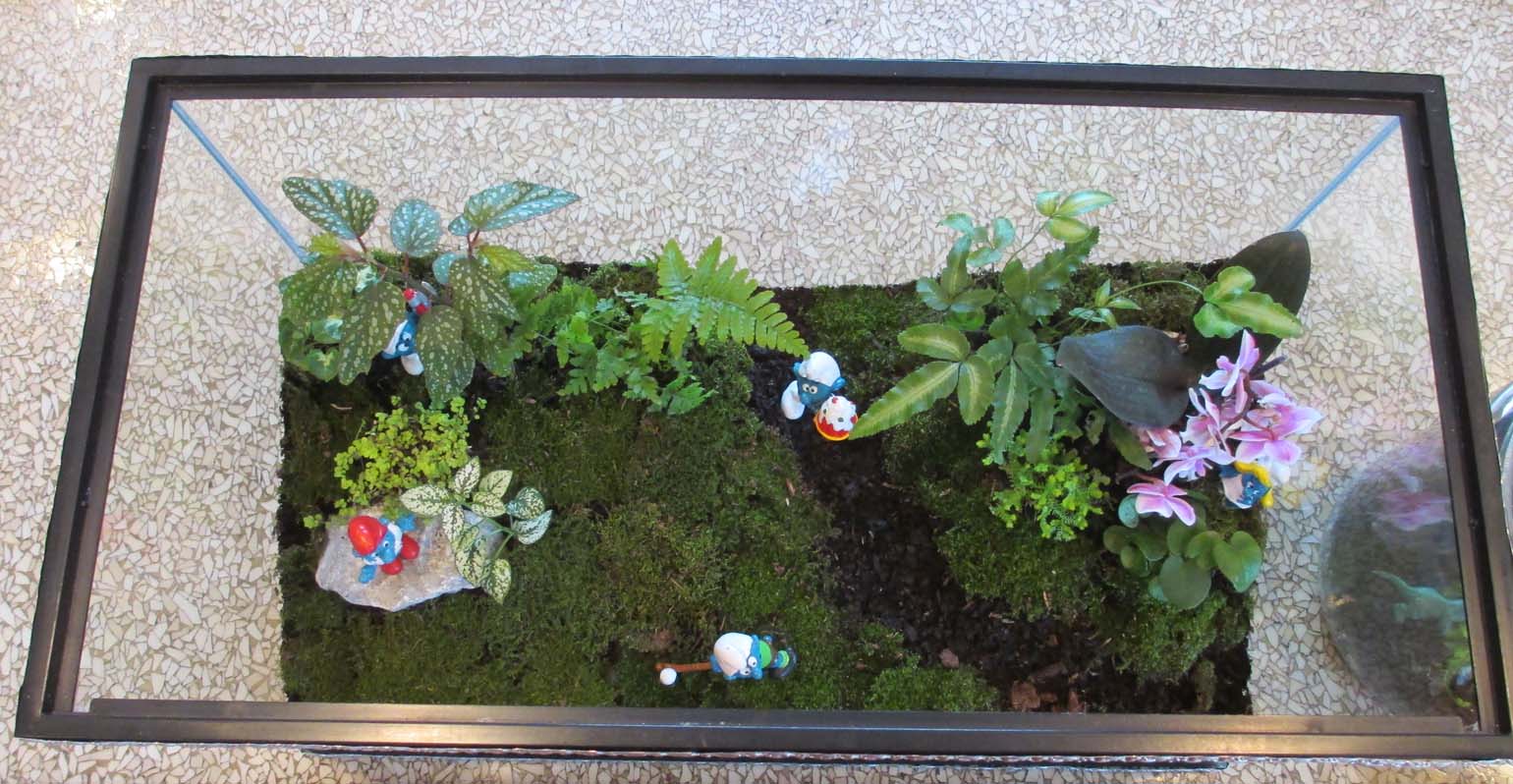
Here's an aerial view that's not affected by the reflections.


And a closer view... The plants, from left to right are (back row): Butterfly Syngonium, Begonia, Autumn Fern Dryopteris, (center): Baby tears Soleirolia and Polka Dot Plant Hypostes. The groundcover is one or more kinds of moss I found growing in my windbreak.

I thought this little guy was the funniest of all, intent on chopping down the Begonia. 

And Smurfette is hiding among the plants on the other side of the terrarium, which include a Pteris fern, Club Moss Selaginella, Heart Fern Hemionitis, and a miniature Phalaenopsis orchid (the tiny orchid is planted, pot and all, below the soil line). 

An overview of the terrarium with the partial lid on. I placed a humidity sensor inside for a while to see how humid it was in there, even with only the partial lid.


Since I had a few plants left over and I also had a lidded glass jar that I wasn't using for anything, I decided to make a second terrarium, with a dinosaur theme:


 Two toy dinosaurs and a fossil accompany the ancient ferns and other plants in this 
smaller terrarium. Again, it's hard to get a good photo through the glass.

A clearer photo from above. The plants in here include what I think is probably a miniature Alocasia, a Lemon Button Fern Nephrolepis and another Club Moss Selaginella.

This project was a lot of fun and just the sort of thing to occupy a northern gardener during the winter months. The process of making it and figuring out where to put the plants and toys was the best part, but I'm also looking forward to seeing how the plants grow (or fail to thrive and then die, as also happens sometimes) in the terrariums.

Before this winter, I knew almost nothing about indoor plants, but I've slowly been learning a bit over the past few months. Making and caring for a terrarium is yet another part of indoor gardening that I've enjoyed learning about.

I highly recommend making a terrarium -- it's fun to do and the plants require less care than other house plants, because they don't need to be watered as often due to the higher humidity, which also results in healthier plants than the dry, centrally-heated air in our homes does. And if you have children or grandchildren, they often find terrariums as fascinating as we do.

Thanks for reading! -Beth