Showing posts with label Pests. Show all posts

Thursday, July 2, 2020

Lily Time!


Hello everyone! I hope you are enjoying some beautiful summer days in your gardens -- I have been pretty busy in mine recently.

The weather is starting to get a bit hot and humid again, which shouldn't be a surprise, since it's summer in Iowa -- but it's time to turn the air conditioner back on again after a few weeks of cooler, rainy days.

But I've been using the cooler days (and a few hot ones too) to work outside to maintain and improve my garden areas -- some of which were looking pretty weedy and overgrown with grass in the last year or two. I've cleared a few areas entirely, and replanted other areas that I cleared last year (and the year before). Things are now starting to look a bit more under control.


The Pond Gardens are looking much improved this year, for the first time in several years. Two years ago I cleared them of the grass that had invaded them, installed a metal edging around the paving stones last year, and replanted them this year with annual petunias and dahlias, in addition to the roses and boxwoods that remained. This area has a well-kept, park-like feeling now (the two new benches helped with that too).
 

Here's another area that looks much better this year: behind my garage. This very long bed was completely infested with grass and weeds two years ago, so I cleared it and last year I planted a bunch of hostas that I moved and divided from another area (mostly from the Yellow Garden, so many of them are golden in color). This bed looks SO much better and is easier to maintain, now that the hostas have filled in to crowd out weeds.

Another area that is much improved this year is my new Tropical Garden around my patio. The plants have started to grow a bit since I planted them about a month ago. It won't look truly jungle-y for at least another month, but I'm pretty happy with it, and I've managed to keep it weeded and well maintained so far. (Please ignore the "project" waiting on the sidewalk at right....)


A closeup of the shady front border in the Tropical Garden -- complete with Jungle Cat snoozing among the tropical foliage. :-)

And this mock orange (Philadelphus) hedge is looking (and smelling) better than it ever has. I cut it down to half its height two years ago, and that has made the shrubs grow back much more thickly, and bloom heavier than the ever have before. The scent can be smelled across the yard.


Lily Show

The big current story is the lilies, though. The Asiatic lilies have been blooming for the past couple of weeks, and now the orien-pet lilies are are coming online too.

These Asiatics in the Paradise Garden look lovely in this pink shade.


These trumpet lilies (whose name I have lost) are blooming in the Paradise Garden too.


And these orien-pet lilies just opened today and have a wonderfully strong scent. They perfume the entire Paradise Garden -- and what should a Paradise Garden be, if not a scented garden? This evening  was magical outside after dusk.


Invasion!

But it's that time of year again: the cursed Japanese beetles have again invaded our gardens.


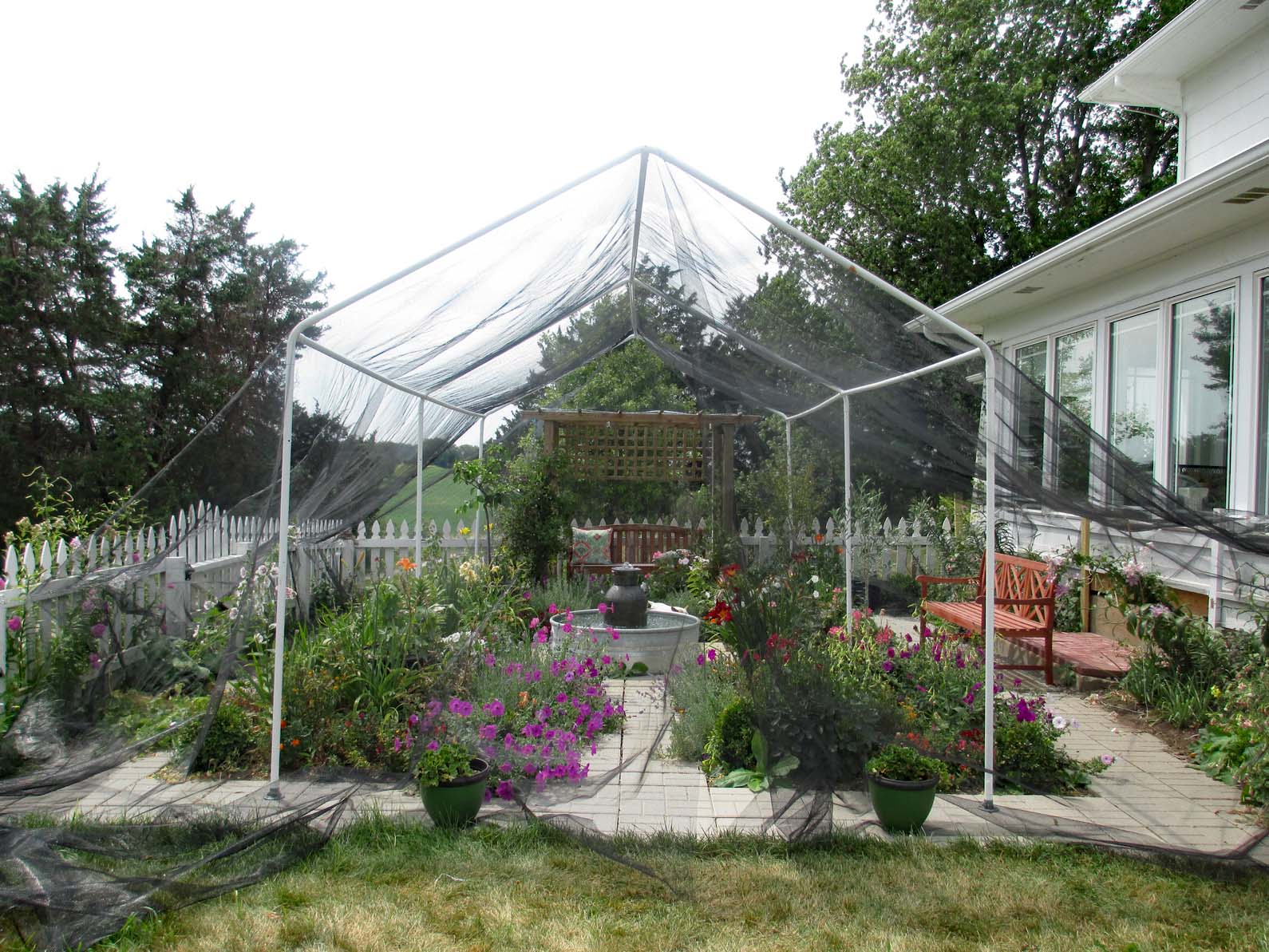
So up went The Big Net. This is the third year I've put it up, and I feel safer under it now that the buggers won't be able to chaw on my roses and mate to create even more of their horribleness. I wish I didn't have to put it up (it prevents the butterflies from flapping about in my garden -- at least until September, when they again have glorious free rein) but it's much better than the alternative:


Sorry to show you this hideousness, but it's important to realize just how horrible
the alternative is. This was two years ago  in early August, BBN (Before the
Big Net). Uggh.


Entering my Bedouin tent -- where roses can flourish freely all summer. Much better....


I hope you are able to enjoy magical evenings in your own gardens now that summer is truly here -- I can't believe that the 4th of July is already upon us. (I think this every year; the holiday always makes me feel a bit sad, as it marks the peak of summer, after which it's a long slide downward to the trough of January. 

But there are still many nice evenings ahead this summer and autumn for us to enjoy. Thanks for reading! -Beth


Sunday, August 11, 2019

The Big Net 2.0


Greetings! Those of you who read my blog post last August may remember my idea last year to defend my roses and other vulnerable plants from the Japanese beetle scourge: The Big Net.

As I wrote then, the JBs have gotten worse every year since I've been gardening (they were hardly seen in Iowa when I moved to my current house and started gardening seriously a decade ago). They've really made gardening a lot less enjoyable during the period from late June to early September (although there may be fewer of them this year, or at least they may be less active, due to the cooler weather we've been having, compared to last year).

Uggh!

Last year, I tried just about everything I read about: insecticides, deterrent sprays, milky spore, knocking them off into a cup of soapy water each evening. But nothing really worked. I didn't want to put nets over each and every flowering plant, so I bought a temporary metal structure over which I draped a big net to cover one whole flower garden area, my Paradise Garden, in which most of my roses are located.

As you may recall, the net worked pretty well last summer to keep the JBs off the roses and other flowers in my Paradise Garden -- until a storm with gale force winds of 70 mph tore the net in several places. I was able to clip the pieces together enough to hold up until the end of summer, but I vowed to try again, with several modifications:


Last year, I attached the grommets (that tethered the net to wires on each side) directly into the netting, but the wind tore the grommets right out of the net. This year, I reinforced the lines of grommets by inserting them through strips of back-to-back weather-resistant Gorilla tape on both sides of the net. We'll see if this helps....

The other major tearing of the net last year occurred where it was draped over the wood pergola at the end of the garden: the sharp ends of the wood tore into the net and the wind pulled the net so hard that it continued the tear nearly clear through the entire width of the net. This year, I covered the ends of the wood with hollow golf balls and a couple of small plastic pots stuck on the ends of the wood. Again, we'll see....

I moved most of my remaining roses into the Paradise Garden this spring, and gave away my climbing roses, which, unlike rose shrubs, can't be simply cut back after their first flush of flowers, as it defeats the whole purpose of climbing roses. Marigolds and daylilies are also attractive to the JBs, so most of those are planted in this area too. And I can move any potted plants that are targeted by them under the net as well.

The Result:

Since I put the net up several weeks ago, the number of JBs in my Paradise Garden has been greatly reduced (somehow a few still seem to be getting in, but not very many). My roses are starting to look healthier and less eaten than they were after the arrival of the JBs at the beginning of July until I got the net up several weeks later.

It's been nice to simply sit and enjoy my garden, smelling the flowers, and lightly puttering around deadheading and pulling a few small weeds like usual, instead of being aggravated by the bugs ruining my flowers. We'll hope that this continues for as long as the JBs are around.

Here are few scenes of the Japanese beetle-free beauty under the tent:


Buisson (bush-type) dahlia 'Jaipur,' starting to bloom in front of self-seeded tobacco and petunias. I can't believe how well these new French dahlia hybrids from Ernest Turc bloom, 3-5 feet tall and no need for staking. I really wish that more of them were available here in the United States (Brent & Becky's Bulbs has a few varieties, but I want more kinds!)

Pink flowering tobacco, lavender, petunias and 'Rooguchi' clematis, top.

Daylily 'Pardon Me' and petunias.
Roses (I think this might be the Buck rose, 'Hi Neighbor,' but I can't be certain) and lavender.

Oriental lilies and 'Persian Market' daylily.
Tall pink 'Ruby' snapdragons and other flowers.

The most enjoyable time in this garden is in the cool of evening and nighttime. I found this solar-powered LED lamp at Theisen's farm store this spring, and the cut-outs in the metal cast a beautiful pattern that fits in well in my Islamic-style Paradise Garden. 
Here's what the lantern pattern looks like when I set the lantern on the paving stones in the garden. It's really pretty magical at night.
Daylily 'Red Volunteer'.

This garden truly is my paradise. I've enjoyed making other garden areas, but never derived so much joy from maintaining and inhabiting a garden area as I have with this one. (And look at those roses, beautifully free from munching beetles!)

My revised Big Net seems to be doing the job. I hope the information about my trials and errors with it will be helpful to others trying to deal with the Japanese beetle scourge. Midwesterners can still grow and enjoy roses!

I hope you are enjoying your own gardens, filled with blooming flowers, and free from insect damage, as we reach the height of summer. Thanks for reading! -Beth

Friday, August 17, 2018

My latest (crazy?) defense against Japanese beetles

The butterflies are magical, but they're not my only garden visitors....


It's official: the Japanese beetles are out of control. They're ruining my roses, hollyhocks and other flowers. I know they'll be gone before too much longer, but they've been absolutely horrendous this year and I don't see them being any better in future years.

I didn't mind them so much when I had few roses near my house, but now when I sit in my new Paradise Garden each evening surrounded with roses and other flowers, seeing the damage and ugly clusters of beetles really bothers me. I think my new garden is probably the nicest garden I have ever made, and I'm not going to give it up or stop growing roses in it, so what to do?


It's magical in the evenings, filled with butterflies, hummingbirds and scented flowers. The JBs hadn't gotten this rosebud yet for some reason -- but the next day it was destroyed.


This climbing rose growing on the arch over my front gate was repulsive! This foul sight greeted me every time I came home until I pruned the plant down almost to the ground in disgust.

My 'Sharifa Asma' rose, known for its scent and
beauty, was utterly defiled by the disgusting beasts.

Even the marigolds planted in my Paradise Garden weren't immune -- I was surprised, as they have long been thought to act as a repellent to other insects. But the JBs love them (although they don't seem to cause as much damage to the leaves and flowers as they do on roses).


Last month, I posted about the Japanese beetle problem, and at that point I felt pretty hopeful about my efforts to control them, but I think that was unrealistic:

1. Every evening I walk around with a container of warm soapy water and use a butter knife to knock off as many JBs as I can find into the container. This does seem to somewhat reduce the damage done by them, and it makes me feel better -- but this is not how I want to spend so much time in my gardens.

2. I don't want to use systemic insecticides because I don't want to hurt the bees, and they only reduce the problem anyway, not eliminate it. So instead, I sprayed an organic pyrethrin-based insecticide at dusk, after bees go to sleep. The pyrethrin did kill the JBs that were on the plants -- the ground under the roses was littered with their bodies the next day. But more showed up the next day and didn't seem to be affected by the residue. Also, it made my Paradise Garden smell like insecticide, not sweetly-scented flowers. Yuck.

3. I planned to treat my lawn for JB grubs this month to try to reduce their future numbers. But my two acres of lawn would have cost probably $150 to treat, twice a year, and I found out that the JBs can fly 3-5 miles, so more will simply come from miles away. Useless.

4. I treated my lawn with milky spore treatment about five years ago, but I've read that studies have shown it doesn't work very well. Ditto nematodes.

5. I wondered if a simple repellent existed, and I was excited to read that steeping red cedar planks in hot water would yield a spray that some people swore by -- free and easy! I tried it and I could certainly smell the cedar spray -- but the JBs didn't seem to mind it at all, and in fact the three test plants I sprayed had even more beetles the next day. Aaggh!

*****************************

I apologize for my pessimistic attitude, but the more I research Japanese beetles, the worse this story gets -- next year and every year after that will probably be just as bad, if not worse. And my aesthetic problems with them pale in comparison to others' more serious problems. They cause millions of dollars in damage to crops and ornamental plants; last year, an Iowa winery lost $20,000 of their grape crop to the buggers. They're also destroying milkweed habitats that monarch butterfly populations depend on to survive. They only arrived in my area about a decade ago, and didn't seem so bad a few years ago because the unusually cold winter of 2013-14 knocked back their numbers. But I think this rebound is the new normal.

And it's not just a problem for Northeasterners and Midwesterners; Portland, Oregon has been quarantining and desperately trying to eradicate a suburban infestation of Japanese beetles that threatens the Pacific Northwest's huge agricultural sector.

Steadily moving west....


And they've already spread to Europe too: JBs were found in a nature reserve in northern Italy near Milan in 2014, and by last year they had already spread to southern Switzerland. Etymologists believe most of continental Europe, the UK, Ireland, parts of Australia and New Zealand are all suitable habitats for them. The Netherlands has long been dreading their arrival; since the 1950s they've had Japanese beetle traps at the international airport in Amsterdam to monitor for them. English gardeners had better enjoy their national love affair with the rose while they can.

Their invasion is inevitable everywhere, except very dry and extremely cold areas  -- I only hope that someone really smart will figure out how to eradicate them easily and cheaply.  They're invasive pests that shouldn't even be here, and we should target them for total continent-wide eradication, if it can be done without harm to other species or the environment (genetic engineering to render them sterile may be the safest way to do this).

But back to my own (admittedly minor by comparison) problem right now....


My Latest Desperate (Crazy?) Idea


If insecticides, hand removal, grub treatments, milky spore and repellents don't work, what else? Some people have put netting and row covers over fruit trees, berry bushes and grape vines, but I don't want to have nets over each of my rose bushes and on every marigold and dahlia, preventing me from enjoying their beauty. How ugly would that be?

But then I started to wonder: Could I put a very big temporary net over my entire Paradise Garden? That's where most of my roses are and where the JB damage bothers me most. I looked this up online and couldn't find any examples of other gardeners who have done this -- maybe that should tell me something.... I saw pictures of bird netting enclosures, net cages for fruit gardens, and netted cat enclosures ("catios"), but no beetle-netted flower gardens.

I'd need a pretty big net to cover my roughly 24'x27' Paradise Garden. However, I looked around and found beetle net sold in rolls 100' long by 14' wide on Amazon.com.

And how could I support the net over my garden, so that I could still go inside and enjoy my garden? I'd need some structure that's inexpensive, easy to set up and take down, and not hideously ugly. I hit on something that I hope will work:


It's not too ugly, I think, for a temporary structure. It's a 10x20-foot shade canopy or carport frame (it comes with a cloth roof, which I'm not using), that I found at a local home improvement store for only $80.

When the net arrived last Friday, I unrolled all 100 feet of it out in our big yard, and cut it into three sections, each 33 feet long and 14 feet wide. I then sewed those three sections together by hand using nylon twine, making a 42-foot long, 33-foot wide net.

Getting the net over the top of the structure all by myself (family's away camping) wasn't the hard part. After that was done, I spent two days attaching grommets to both sides of the net, so I could attach the net to wires strung in front of my house and along our front fence, so the net won't blow away when it's windy.


It could look worse. I like to think of it as being like a Bedouin tent, in keeping with the Islamic-style Paradise Garden theme.

I have no idea if this is going to work. I've read that JBs don't usually fly along the ground, but swoop down from up high when they smell pheromones emitted by female beetles already eating flowers and foliage. So having a net over the top of this garden may exclude new ones from entering.

There were still a fair number of them already in the garden though, so I've been working overtime with the soapy water bucket to eliminate as many as possible from inside the net. I have noticed a lot fewer of them inside the tent after several days, and I see some on the outside of the net that can't get in. :-)

Hah! You just stay out there!


I'll only have to put up this temporary net for 8-10 weeks, from mid-June until late August each year. Then, I'll pack it away carefully until next June.

I feel a bit bad keeping the butterflies and hummingbirds out (they were so magical!), but they'll have free rein in this garden all during autumn, and I have numerous zinnias, phlox and other nectar-rich plants in other parts of my garden for them to enjoy during mid-summer. If the JB's must have those plants too, it won't bother me so much, as long as I have my safe rose sanctuary in my netted Paradise Garden.

If this works, it could be the best way to protect roses in JB-infested regions:

  • safe for the environment and other insects
  • temporary
  • less expensive than treating large areas of lawn for grubs
  • more aesthetically attractive than netting that places a barrier between us and our plants 
  • and effective!


Welcome inside the Bedouin tent.... I cut a door flap in the front of the net, to make it easier for people (not beetles) to enter.


I'll move a few more roses from other areas into the PG, and I think I'm just going to have to get rid of all my climbing roses, since needing to cut them back drastically each summer pretty much eliminates the entire purpose of climbing roses. I'll probably replace them with clematis or some other flowering vine that blooms before the buggers arrive.

I'll keep you posted about the effectiveness of my crazy big net.

Until then, I hope you have been enjoying lots of lovely summer flowers, not munched by insects, in your own gardens. Thanks for reading my very long post! -Beth


Look, no beetle clusters! Only lovely roses and sweet peas and petunias.
Maybe the net's not so crazy? :-)

Saturday, July 21, 2018

Rain and glorious roses -- and Japanese Beetles!

A deep pink rose (possibly Buck rose 'Hi Neighbor') planted with dianthus in my Paradise Garden.

Hello! The good news this week is that we've finally gotten some significant rain, after a month of zero rainfall. Thursday we got more than two inches, which, with the 3/4" we got a few days before, means we're back to normal precipitation for this time of year. A great relief -- I don't even have to water my numerous potted plants for a couple of days!

Everything looks fresh and green after the rain, and we've been enjoying lovely roses, lilies and other flowers the past few weeks. Here's a selection:


'The Fawn' rose and pink flowering tobacco against my front porch, on the edge of the Paradise Garden.


Another rose. I've moved my roses around so many times that I'm afraid I can't identify this one, despite efforts to keep track of them when moving them. This is probably a a Griffith Buck rose though.


The bubbling fountain with orange marigolds in the Paradise Garden.


But all is not perfect in my Paradise Garden.... we've been INVADED! Yes, by the same Japanese Beetles that have been wreaking increasing havoc in the Midwest in recent years. They've been observed in the United States for more than a century, but have been present in Iowa for only the past decade -- and last year was the worst infestation of them on record. I don't know how this year compares scientifically yet, but by my own observation and the many news stories appearing across the Midwest such as "The bug that ate Omaha," I'd say that they're pretty prevalent this summer.

They've clustered on my roses, devouring the flowers and leaving the leaves as skeletonized webs. They've done the same to our lovely hollyhocks, and even chawed down on marigold flowers and foliage (I'm quite surprised any insect likes such strongly-scented foliage).

Six or eight years ago, I treated our lawn with milky spore powder (a bacterium that is toxic to JB grubs), but I'm not sure that it has done much to help, since I still see plenty of grubs (one of the stages of Japanese Beetle life) under our turf in the areas I treated. But other than that effort, I've done little to battle them, mostly trying to ignore them and the damage they leave in their wake.

Until now.


This is only one Japanese Beetle -- usually a rose is covered in a large cluster of the buggers.
Puppy knows there are moles under our lawn, and the moles are there because they like to eat the JB grubs. This part of our lawn isn't too chewed up yet, compared to some other areas that I'll spare you from seeing.

Until now I've mostly tried to ignore the JBs, but last week I decided that, now that most of my two dozen or so rose plants have been moved to my Paradise Garden right next to the house and I can see how much damage the Japanese Beetles are causing, that it's just not acceptable if I can do something about it. It's not just the ugly clusters of beetles covering my rose flowers, but the unsightly skeletonized leaves of the roses bushes and hollyhocks. Enough.

My strategy is a four-pronged one:

1. Every evening when the JBs have settled down on my plants and are less likely to buzz around, I walk around with a container of warm soapy water and a butter knife. I use the knife to knock off as many JBs into the container as I can find (some evenings I've done away with 100+ of them). I've been doing this for about a week now, and I'm certainly seeing a lot fewer of them than when I started. It could be that their active phase, usually only 6-8 weeks, is nearly at an end, or perhaps the big rain we got the other day knocked them all to the ground (where they are busy laying their dastardly eggs...), or because of the cooler weather we're enjoying after the rain. Removing them by hand does help though, because when feeding on plants the JBs emit a pheromone that attracts even more beetles to the plant -- each one you remove prevents several more from being attracted to the same plant. It's important not to squish them though, because that releases even more pheromones. (And it would have been better if I'd started doing this as soon as they first started appearing -- but it wasn't until last week that I'd had enough of them.)

2. I sprayed an organic pyrethrin-based insecticide on my roses, hollyhocks and marigolds. I did this at dusk, after the bees go to sleep, to avoid harming them (there is no residual effect on bees, but it can harm them if they visit just-sprayed plants, so late dusk is the safest time to do this).

3. I am planning to treat my lawn for grubs in the next month, to try to knock back the future numbers of JBs, as well as reduce the mole (and dog) damage to our lawn. Because there are no neighboring lawns near me (my property is surrounded by corn fields) this may be more effective than for gardens in cities or towns.

4. I may try another milky spore treatment of my lawn, for the same reason.

Next summer, I will keep my eye out and start the soapy water treatment as soon as I see the first JBs, to get a good start on them before they attract large numbers. 

I may be fooling myself into thinking that I can do anything to eliminate this serious pest, but even if I can reduce their damage by 50% or so, that's still something, especially in my Paradise Garden, in which roses are one of the starring plants.


But enough about the Japanese Beetle scourge -- luckily, they don't seem to have developed a taste for many other flowers (yet...). Here are a few others:


We haven't yet had to deal with the dreaded Lily Beetles that have ruined these amazing plants for our British gardening friends (and I pray that we won't have to for some time yet). They sure are looking nice this time of year, and smell wonderful.

After my potted jasmine plant (Jasminum sambac) died this spring, I was on the lookout for a replacement. I found two -- a regular single-flowered form like I had, as well as this new double-flowered one, 'Summer Soul." A wonderful scent....


I'm never failed to be amazed by the size of the flowers on hardy hibiscus plants -- they really do look tropical!

A pelargonium I ordered for the first time this year called Geranium 'Appleblossom Rosebud,' an older heirloom variety, c1870, that is said to have been Queen Victoria's favorite geranium. If the story's true, I can see why.


It looks like we'll be enjoying cooler weather here for the next week or so, which is a relief after our usual summer heat. It's been pleasant to work outside, and I've actually been able to keep reasonably on top of the weeds this week, which is a great improvement over last year's weed-fest, and makes me feel a lot better about my gardens in general.

Hope you are enjoying beautiful weather and adequate rain, and that your gardens are not too terribly plagued by pests of any sort. Thanks for reading! -Beth