Sunday, January 5, 2014

Book Review: "Inside Out: Relating Garden to House" by Page Dickey

"Inside Out: Relating Garden to House" by Page Dickey was published in 2000, but even though I try to write reviews of newer garden books because those are most helpful to purchasers (I post a shorter version of my reviews on Amazon), I still like to review older garden books that I have learned something from or enjoyed reading.

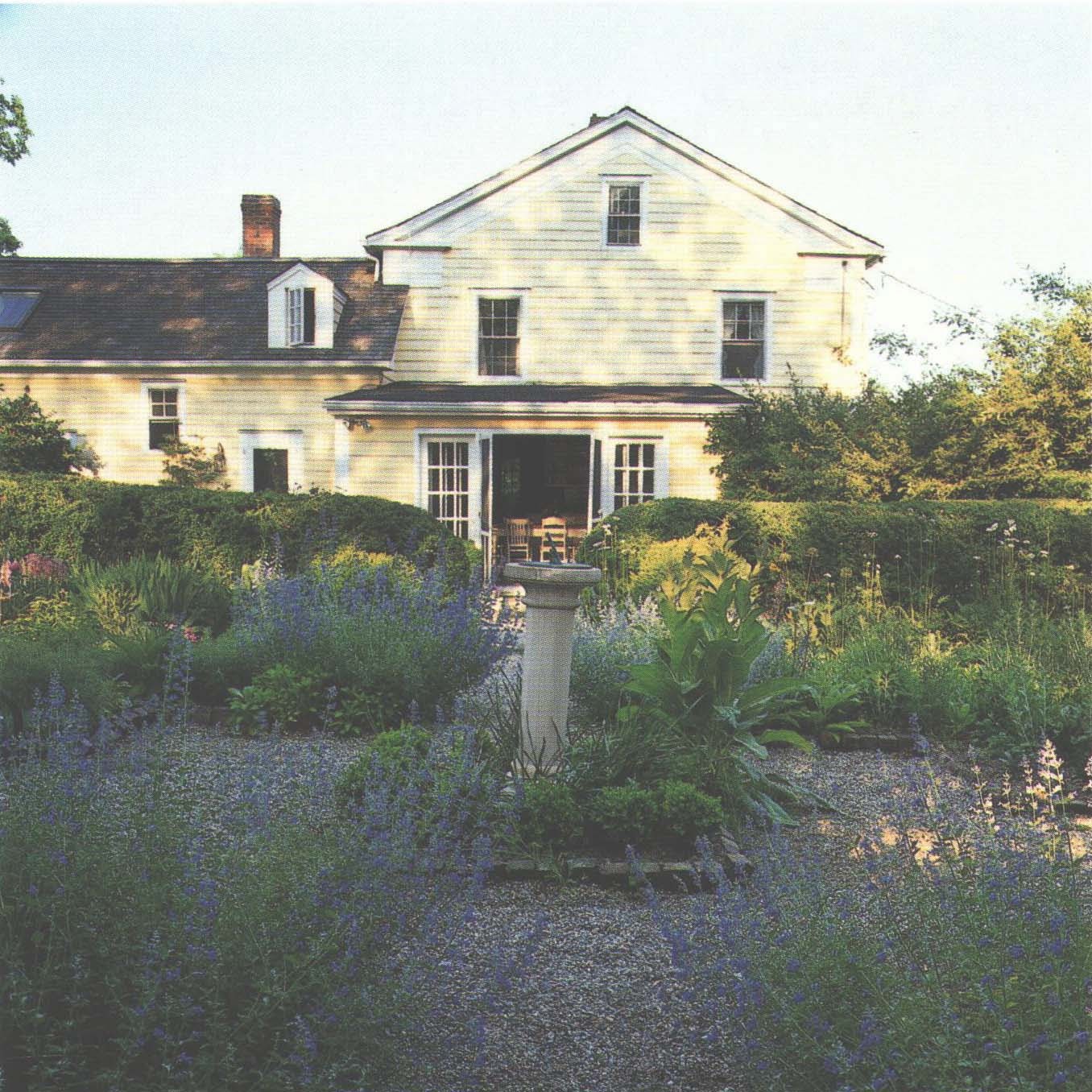
"Inside Out"  is a garden book of two types: First, the book begins with a short Introduction in which the author relates how her mostly formal gardens are laid out in relation to her small farm house, and provides brief advice about how to achieve this in your own gardens. In addition to half a dozen photos of her lovely house and gardens, she also includes a small map of the layout of her property and its gardens, something that is one of the most helpful aids in describing a garden (but is unfortunately not provided in most garden books). The map shows how her garden areas line up with the sides of her house and the main entrances and windows, which is the major point she is trying to make.

The view from the author's porch.
What lovely crabapple trees!
The author's herb garden lines up
perfectly with her kitchen door.

The garden map of the author's garden, showing how the axes of her garden areas intersect with the doors of her house. And a beautifully drawn map too.
In the Introduction, she offers the most important piece of advice about how to start when designing a garden: look carefully at both your house and its surroundings. These are the main points that I gleaned from her Introduction (in my own words and with my own observations added):

1. Stand at your windows and think about what you see from them and what you might rather see from them.
2. Stand in your doorways and think about the paths leading to your house and away from it (or plan them logically if they don't exist already).
3. The outlines of garden beds should bear some relation to the footprint of your house.
4. Consider the setting of your house: a house in the country needs a different sort of garden than a house in a small town, a suburban house or a house in a big city.
5. The architectural style of your house (which sometimes is determined by your region, but not always) should play some role determining the style of gardens that are appropriate for your property. A formal, symmetrical house probably needs equally formal gardens (although there is always leeway for romantic plantings within formal beds); a small cottage needs a garden appropriate to that style of house; a modernistic house needs a different garden layout than either of the other two.
6. There are important regional differences in both the styles of gardens and in the types of plants used in each region. Look at which plants are commonly grown in other gardens in your area; these are usually popular because they grow well in your area, and they might also have a traditional historical significance to a region as well. Rather than fighting what is common and trying to be "original" in your plant choices, start with what grows well and looks right in your region, and then experiment with new plants after that.
7. But personal tastes are very important too: grow the kinds of plants you like in the arrangements you like. Some people love cool, green foliage and simple mossy areas; other of us love bright, sunny flowers in abundant cottage gardens; yet others live for the fragrance of plants, or prefer only productive fruits and vegetables for their kitchen. Having an "appropriate" garden is good, but it should also delight you, especially if you plan to live in your house for the long term.

After the author's Introduction, however, the book changes into the second kind of garden book: portraits of 13 very different gardens around the United States in various regional styles. Included are gardens in:
  • Connecticut (a weathered New England A-frame house with added screened-in porch and conservatory, surrounded by paved areas and a handsome pergola) 
  • Arizona (a southwest desert style garden around a modern stucco house), 
  • two in Illinois (both a formal, old-money garden laid out in the 1920s and a prairie-surrounded house)
    The old-money Illinois house, with its 1920s garden
    layout. Note how the oval pool lines up perfectly
    with the living room window and the bedroom window
    above, affording lovely views from both.
    What could be more right than this design?
  • four in New York:
    1. an artist's billowing farm garden
    2. a fascinating green garden, clothing the walls of a two-story ruin of an old mansion
    3. a Manhattan rooftop garden where because of the drying winds, only Zone 4 plants can survive even though Manhattan is in Zone 7
    4. an architect's upstate New York farmhouse with a classical temple folly
      New York garden #2, lush growth filling the
      ruins of a long-burnt mansion.
  • two in Texas (a boldly-hued, exuberant Texas-style take on Monet's garden and a peaceful Zen retreat of raked gravel and minimalist plantings), 
  • California (a tiny but lush garden surrounding a San Francisco row house)
  • Florida (a jaw-droppingly fabulous oasis of palm trees and other tropical plants surrounding a pool and waterfalls and enveloping a house that opens almost completely to the garden by sliding glass doors on all sides)
  • Maine (a perfectly normal white clapboard house appended by a minimally heated greenhouse built of salvaged windows to enclose a mimosa tree with breathtakingly beautiful yellow blooms, an orange tree and other tender plants growing directly in the ground in this Zone 5 location)
The Florida paradise, as seen from the open walls of the
house. This is as fitting to the site as the oval pool
is in the Illinois property.
This second part of the book is written in the style of most garden books that describe beautiful gardens and how they were made, however, the author does not specifically mention the points she made in her Introduction and how these properties illustrate them (and garden maps were provided only for 5 of the properties).

The properties themselves do illustrate quite well how the gardeners have worked with the sites and regional growing conditions to design gardens that are appropriate for each location, but it's not always obvious what lessons the reader -- especially a beginning gardener reader -- can take away about planning gardens in relation to their own houses.

This was an enjoyable book filled with beautiful garden photos of memorable gardens, but I wish there had been more of the first kind of writing, specific advice about garden design, and less of the second, main, part of the book simply describing gardens. For experienced gardeners, the descriptions will contain lessons about designing gardens, but others may want more explicit advice followed by specific examples.

Book Review: "Slow Flowers" by Debra Prinzing

Filled with ideas for growing and arranging
flowers in the home.
"Slow Flowers" was published in early 2013 and has an interesting premise for a book: The author, a west coast garden design expert whose writing I was familiar with from one of my favorite magazines, Country Gardens, decided to see if she could make a bouquet from locally-grown flowers every week of the year.

She didn't grow all of the flowers and other materials such as branches and leaves herself, although quite a few did come from her own garden or those of friends. She avoided blooms imported from other countries, although she did buy them from local professional growers, some of whom used greenhouses to continue growing during the winter months.

Obviously, since she lives in the Seattle area, she was able to "arrange locally" more easily than many of us who live in the midwest or the northeast, where we would be pretty hard-pressed to get many blooms during late fall, winter and early spring without spending a fortune on heated greenhouse flowers.

But even though she is from a warmer climate, her book is still useful to the rest of us. In the back of the book, she included a very helpful list of all the plants included in her bouquets, and I noted that the majority of them would grow here in the midwest, either as perennials or as common summer annuals.

And many of the bouquets included branches with leaves and berries in the fall, forced bulbs (spring bulbs planted in pots in the fall and brought inside to warm up and bloom before they would outside) and flowering branches cut in bud and also brought inside to bloom early. These are all materials that are available to colder-climate gardeners, if not during all 52 weeks of the year.
These kerria japonica and flowering quince branches
are naturally beautiful to behold in their simplicity.

Since I started my own cutting garden last year, I have been interested in suggestions for different kinds of flowers to grow than the commonly grown ones, and this book did provide me with ideas that I can use to have more blooms, especially early in spring. I plan to plant a number of early-flowering trees, shrubs and bulbs this year and this book made it clear how beautiful these can be inside the house. And I will also try to plant some shrubs with good berry colors for fall.

The book also has a number of sidebars containing practical information for cut flower bouquets: for example, how to make hellebore flowers last inside (wait until they start to develop the seed pods before cutting them), how to use flower frogs (cages that fit in the bottom of the vase) to help flowers stay upright without the use of that bacteria-laden green foam, and numerous other practical and aesthetic flower-arranging tips.

"Slow Flowers" is altogether a useful and idea-filled book, and one well-worth reading several times over for maximum understanding.

But I do have to say, that even though her autumn and winter arrangements were attractive (especially the ones that relied on greenhouse-grown flowers), nothing can compare to the breathtaking freshness of daffodils and tulips in spring, a bowl of just-cut peonies in May, full-blown roses in June and great big dahlias in July. These flowers signify the fleeting nature of youth, the fragility of all life, and their beauty fills the human soul with awe for the transience of all things.
Peonies and alliums, with lady's mantle foliage.
Late spring at its most magnificent.

Does bringing in fading leaves and denuded branches -- signs of senescence, withering, death -- really delight the soul in the same way? Does it make us happy to plunk anything in a vase simply to have an arrangement? Or should we not even try to match the joy of spring and summer and simply look forward to the first blooms of spring (perhaps accelerating them with some early forced bulbs or branches) and perhaps buy a couple of supermarket bouquets to tide us over until then?
Can anything beat poppies in their happy
simplicity?

Is it really so terrible to support local growers in season and support growers in developing countries during winter, or worse for the environment to transport flowers than to heat a greenhouse in the north? None of these questions have easy answers, but I do feel richer for having read "Slow Flowers," which has increased my options for both the abundant seasons and the slower months.


Wednesday, January 1, 2014

New Year's Resolutions for My Gardens in 2014


Happy New Year! This is the time for New Year's Resolutions, and although I've already made a big promise to myself in terms of losing a few pounds and getting in shape (which can only help in making gardening physically easier, of course), there are also many areas of my gardens that I need to improve next year, and perhaps writing about them will make me focus on what needs to be done and motivate me to do it, come Spring.

Some general goals:

1. I would like more early flowers: bulbs, earliest perennials, flowering shrubs and small flowering trees. By March, I'm desperate to spend time outside and see any signs of life that I can, and I've decided that these early flowers give me more joy than the very last ones in October and November do. I'd like to include some early cutting flowers among these: bulbs and branches mostly.
Boy, it makes me happy to see this after a long winter!
2. No more new garden areas this year -- only work to improve the ones I already have.

3. I need to develop a higher standard of maintenance, weeding more regularly, perhaps edging beds? I'd like a neater look in the garden.

4. I'd like to take better garden photos -- better in quality and more often. My father very kindly gave me a nice camera for Christmas, and I resolve to spend January learning how to use it.

Goals for specific areas of my garden:

These will be of more interest to me than perhaps to anyone who might read this, but I will set them down here anyway, in the interest of making a public declaration of what I'd like to accomplish this year. I'll go through the list of my garden areas from my garden map:

1. House
     I really should repaint our white picket fence, and I'd like to have some new, pretty cushions for our porch furniture.
2. East Patio and Gardens
     The east bed of the east patio areas is overrun with grass and creeping charlie, and I should remove at least the smaller perennials and maybe even the rose bushes, spray at least twice over a week with round up to kill grass and pernnial weeds, put a brick border along the back to kepp grass out, and replant. We'll see what gets done this spring....
3. Front Border
    These borders will fill out more, as I completely re-did them in Fall 2012. I'll replace any perennials that didn't make it through the winter, and try to plant or seed annuals by mid-May.
4. Mint Circle
    I'm eagerly waiting to see what the crocus and tulips I planted this fall will come to, and will plant annuals from seed in May.
5. Addition Borders
    I'd like to plant marigold plants and some seeded annuals in orange and purple colors in the front border, improve the blue beds on the west side, and especially find some attractive shade plants for the north side this year. This will require some research, as I know very little about good shade plants. Perhaps some ferns would look lush.
6. White Beds and Pergola
    I'll probably have to replace the non-hardy double white anemone "White Everest" that were sold as hardy (but only to Zone 7!). More annuals. I need to find some way to allow the white clematis to attach itself to the smooth posts  on the back on the pergola. perhaps some chicken wire wrapped around the posts and spraypainted white to match the pergola post?
7. Kwanzan Cherry Tree Grove
    Fertilize? Trim off sucker growth.
8. North Windbreak with tunnel to Celtic Cross Statue
    I'm getting tired making this list already, so I'll plan on leaving this area alone this year...
9. North Border
    a) See how first year's planting fills in and what survives the winter
    b) add more perennials -- I will think about what else might look nice there
    c) plant annuals earlier this year, by May 15.
10. Peony Border
    This is one of the areas that needs careful consideration and much work. I need to remove the nursery bed plants from the north end and replace them with something, perhaps starting a collection of iris. Some more bulbs planted in fall, perhaps. I will think about this some more in the coming winter months -- as this bed in in line with scenic views of fields, perhaps it would be best not to have showy flower displays, at least after spring?
11. Herb Garden
    Plant basil from seed this year as it was unsuccessful from starts the past two years due to drought. Seed by mid-May.
12. East Windbreak with secret tunnel
    Again, nothing here.
13. Rainbow Border
    More annuals, planted and seeded earlier. Assess performance of perennials. Need more blooming in June, and this will require some more thought and research. See how the tulips are holding up.
14. Windmill
    The bed under the windmill has been a disaster, because the trumpet vine planted by our predecessors has been impossible to kill. This year, after the daffodils have bloomed, I will mow them off and mulch heavily with compost. Then I will carefully spray anything that comes up, trying to avoid the two climbing roses (perhaps pruning them back on the edges to make their footprint smaller). I will need to get some kind of deadly biocide tree killer, I think, as Roundup has been unequal to the task. I must get this under control this year.
15. Pond and Four L-Shaped Garden beds
    Use algae control more regularly in spring. See if water lilies survive winter (I left them in the pond this year, as they did not flower last year, unlike their first year.) If they don't come up, I will replace them with new plants. In the beds, plant pink petunias this year (vinca was less than impressive last year).
16. Orchard
    Plant replacement apple and pear trees for the missing ones. See if more daffodils came up this year and take photos. I planted 500 in fall 2012, but they didn't all come up for some reason, and I bought them from a reputable bulb company.
17. Flowering Tree Grove
    Buy two more flowering trees for spots we didn't fill last year, replace any trees lost over the winter. Also, I would like to plant some early-flowering shrubs that I can cut for forcing inside, so I will have more flowers for indoor arrangements.
18. Gazebo
    Plant border around gazebo with easy, drought-resistant, deer-resistant shrubs, perennials and annuals.
19. Garden Shed and Surrounding Borders
    Move hostas from Peony Bed to west side under tree, also buy 'Sum and Substance' large hosta. Transplant ferns next to shed on west and south sides. Other partial sun perennials, annuals?
20. Tractor Shed Pavement and Mock Orange Hedge
    Clear off debris and junk from pavement.
21. East Tractor Shed Border and Fern Border
   I need to find a way to attach the yellow climbing rose to the side of the shed. Whether I should make a large lattice or simply tie the rose to staples is a question.
22. Garage Borders (North, West and South)
    All three of these borders need a lot of work and more plants. The south is blazingly sunny, the west is mostly shaded, and the north is in full shade. I will think about this over the winter....
23. Forsythia Bed
    I'd like to plant some more perennials and perhaps a few annuals here, but I should plant early, since it's difficult to run a garden hose to this bed to water. I'll have to decide what might look good here with the forsythia, the two large peony bushes, the white rose and the mums I planted here in fall. Maybe some nice June-blooming perennials, so garden visitors have something to look at when arriving.
24. Kitchen Garden and Chicken Compound
    I need to put more compost in the beds, and perhaps some garden soil in beds I will seed for cutting flowers, since seeds don't start well in pure compost. We also need more mulch in the paths. both of these could probably wait another year, though, if I can't them done. I want to plant more flowers for cutting, ones that I love to cut but that will be not too much work. I will look into more bulbd to plant this fall, so i will have more early cut flowers in spring.
25. Upper Pasture
    I made a mown grass maze for my children here last summer, but perhaps something different would be in order for this year? Hmm....
26. Fenced Pasture
    I hope our young weeping willow trees survive the winter and last summer's drought. I'd like to see them grow larger in 2014.
27. Lower Pasture and Wildflower Strip
    This year, I will select a wildflower mix that includes some larger-flowered annuals that can be seen better from the road, such as medium-size sunflowers (tall ones might blow over if it's windy).

I have lots of things to think about, research and decide upon over the winter. Here's to a productive 2014!


Saturday, December 28, 2013

Book Review: "The Layered Garden" by David L. Culp

"The Layered Garden"by David L. Culp was published last year, but is such a good garden book that I am going to write a review about it this year. It defies categorization among types of gardening books, being simultaneously:

1. A book describing Culp's own garden, Brandywine Garden in Pennsylvania (zone 6), and the process by which he and his partner made it since buying in 1990.
2. His thoughts about garden design, specifically how to "layer" planting for bloom from late winter through November
3. An overview of his passion for collecting several species of plants, namely hellebores, galanthus (snowdrops) and other small early bulbs, in the vein of a collector's and expert breeder's guide
4. A garden photo book of drool-worthy garden photos and flower closeup photos

This is one of the better garden books I read this year (I requested that my public library order it and wasn't able to read it until 2013), and have checked it out to re-read more than once.

His "layering" advice includes layers in both time and space. Beds can have layers of plants that bloom or leaf out at different times over the year for longer interest. They can also have short, mid and tall height (even climbers for extra tall) plants in them for physical layers. There can also be different areas of a garden that come into their own in different seasons. And whole gardens change over the years as trees mature, plants fill out (or die) and the gardener tries new things as her tastes change.

Culp also tells readers that they shouldn't be beholden to the various rules we hear should govern our garden choices, that we should plant what we like and borrow ideas from any garden that is appealing to us, as long as the plants grow well in our own soil.

But the thing that makes this book so appealing to me is that Culp is not afraid of flowers. Yes, half of his garden is a woodland area, but he has filled it with early-blooming bulbs, shrubs and perennials of the more ethereal sort. And yes, he has numerous other shady areas in his tree-surrounded garden, but he has not limited himself to foliage plants, even in these areas. And yes, he claims that the form of a plant is more important than the flowers as many "sophisticated" gardeners like to claim, but he grows so many glorious flowers in his garden that I really don't believe him.

My scan doesn't do justice to the glorious flowers in
Culp's borders. Now this is what a garden should be!
(It even has a white picket fence -- my favorite.)
It's true that Culp is a self-admitted plant collector and he does seem to specialize in very tiny flowers that can hardly be seen unless on hands and knees (he has a snowdrop named after him because he discovered it on a snowdrop-hunting expedition in an English wood, and his own hellebore hybrids which he breeds). 

But he writes that he is both a plant-obsessed collector as well as a garden designer, something that seems to be all too rare. Many collectors have patches of bitty, hodge-podge collections that enthrall them and other collectors of their particular favorite species (usually something that barely flowers), but which look less than impressive to those who love beautifully designed gardens. But Culp obviously knows how to plant a wide variety of flowers, bulbs, shrubs and trees for nearly year-round interest and still have a glorious show in May and June.

And he also has sections of his garden filled with such showy "common" flowers as foxgloves (which he openly admits he doesn't even grow from seed himself, instead buying the biennial plants in bud each spring!), irises, peonies, lilies and even that bugbear of environmental Puritans: roses (although he claims he does nothing to prevent mildew or even fertilize them, which we do have in common -- however, my reasons are less environmental and more laziness). I even saw begonias in pots! The man doesn't let garden snobbery limit his flowery delight.

The woodland hill area in his garden,
shown at three different times,
from late March to early May.
And he's not afraid of color either. He recalls arguing with the late Christopher Lloyd, the master plantsman of Great Dixter fame, about using strong and paler shades of flowers together (but didn't convince him that it was indeed OK to do this). In general, I believe David Culp has a somewhat renegade, anti-rules, anti-garden-snobbery streak to his character that is quite appealing to me, as a gardener who loves colorful flowers in abundance. 

I believe his overall message is to not restrict ourselves in our gardening, other than not growing what won't grow well in our gardens without cossetting and chemicals. He seems to believe that we need more flowers, more color, spread out over an even longer period of the year. This is a refreshing view in these times, when many "experts" urge us to grow only native species, or opine that flowers are a sign of failure in a garden, or that good garden design has nothing to do with mere flowers, especially brightly-colored ones. 

Not afraid of mixing bold and paler colors, despite what
Christopher Lloyd said.

And he laudably includes a garden map in the endpapers of his book! I just love garden books that provide a map or drawn plan of the gardens (which is one of the reasons I love Country Gardens magazine). Maybe it's just me and other readers don't spend so much time trying to puzzle out the layout of a garden, and which direction the sun comes from, etc., when reading about a garden. (I love literary maps as well; the maps in stories such as the Lord of the Rings and The Hobbit, Winnie the Pooh, and the Oz books; my library wall is covered with framed literary maps such as these). A picture is worth a thousand words.

A garden map adds so much to a garden book.
Why don't more garden books have them?
If I have one complaint about the book, it is that many of the photo captions showing garden beds with multiple plants in them do not identify enough of the plants to make it helpful for those who like the look of a photo but don't know what to plant to replicate the look. Although last part of the book focuses on growing the signature plants in his garden, which is helpful, it still covers only a fraction of the plants shown in the beautiful photos of his beds and borders.

In fact, this might not be the best sort of book for beginning gardeners at all, since the advice given by Culp is not of the basic sort needed by new gardeners; instead, it will be more experienced gardeners who will be able to consider how he has planted his garden and take away ideas for their own plots.

I myself came away with several thoughts: 1) I would like to plant some early-flowering shrubs for late winter interest, as well as more early bulbs. 2) After reading his book earlier this year, I was greatly impressed with those magnificent foxgloves that dot his borders. I tried to start some from seed in pots last summer, but after planting them out in early fall, they mysteriously disappeared within the week, perhaps due to intense heat or drought. I believe I will try planting them again in spring, perhaps trying to sow them in place in early May. 3) I admired the fall-blooming anemones in his fall border, and will try to grow some of those, especially for cutting (although my cutting garden might be too full sun to grow them well...).

In summary, I highly recommend "The Layered Garden" for experienced gardeners or those who love beautiful garden photos.


Thursday, December 26, 2013

Christmas is over, now a long winter of garden dreaming begins

Christmas Dinner

Another milestone toward the beginning of next year's garden season is past: Christmas. This means the official start to the long winter of sitting inside, reading garden books and plant catalogs, planning how to improve my gardens in 2014, and just plain dreaming of a warm, early spring.

Planning for Christmas usually takes most of my mental energy, cleaning, buying presents and food and getting ready to have family over for two days of eating, going to the children's Christmas pageant at church, Christmas day musical concert and of course, Christmas dinner. This year's dinner went fairly well:

  • Herb-roasted rack of lamb (from our own lambs; I had never made a rack before)
  • roasted root veg and onions
  • Brussels sprouts with bacon and garlic
  • "Perfect Harvest" salad kit with blue cheese crumbles
  • cranberry-pomegranate gelatin mold (my own natural recipe) with mandarin oranges
  • too many Christmas cookies for dessert

I spent today cleaning up and putting things away. But now my energies will turn to thinking about my gardens. I wish I could wait another month or two like I used to before gardening became such a serious hobby, but unfortunately, it now seems like the day after Christmas, my thoughts invariably turn to "how to make my gardens better." "What will I do this year?"

I'll read as many gardening books as I can over the next few months -- and I'll try to review them here as well.

Here's to a long winter ahead!


Saturday, December 21, 2013

Book Review: "Private Edens: Beautiful Country Gardens" by Jack Staub


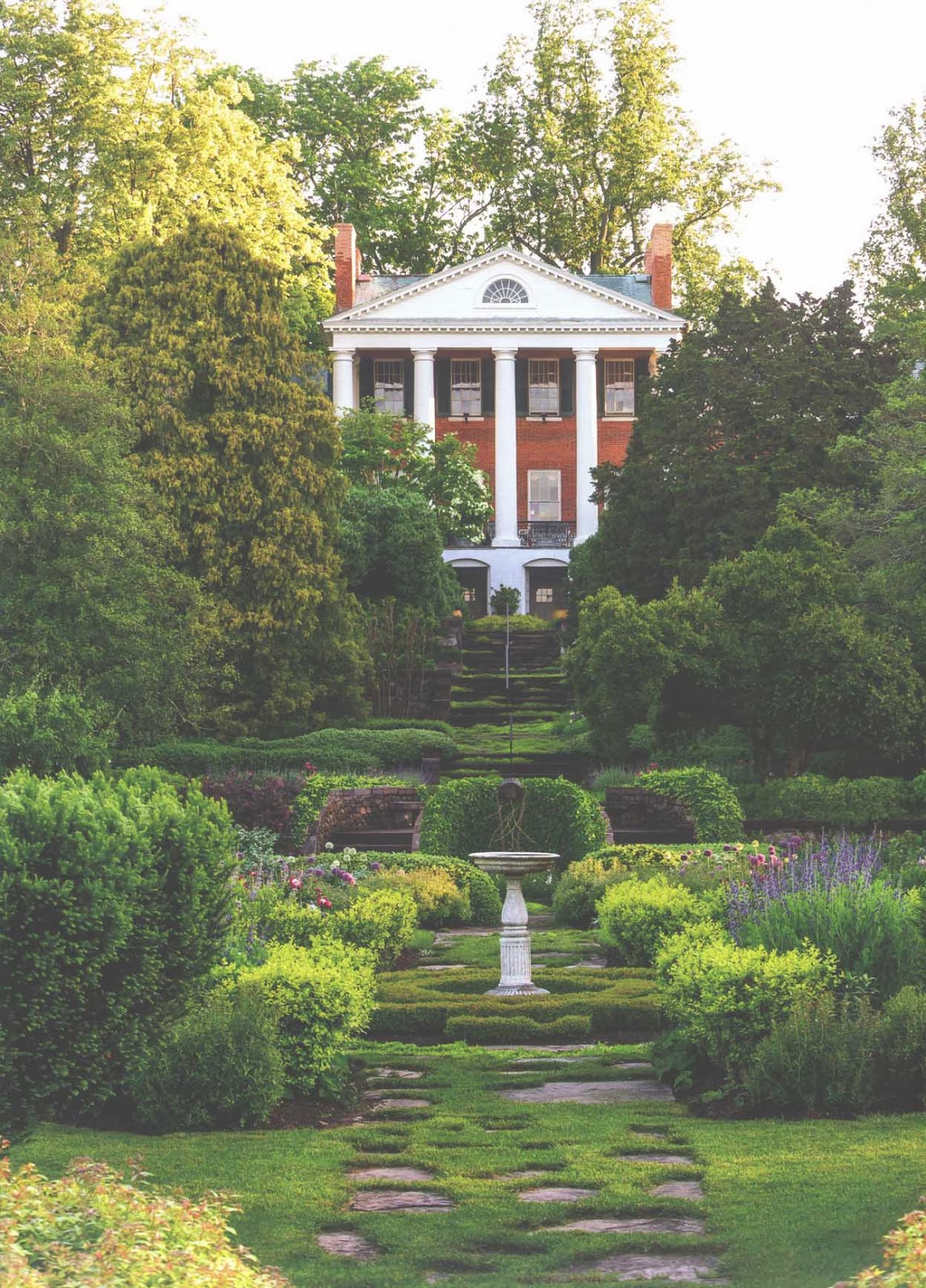
"Private Edens" was published back in March of this year; I requested that my local public library purchase it and I believe that it will be enjoyed by other patrons of the library. The 21 gardens featured in the book are all very beautiful gardens in the eastern United States, most belonging to wealthy people who maintain them to a high standard.

Most of us would never have a chance to see these gardens, as they are mostly private gardens, and many readers will enjoy the photos and descriptions of them.  Where else can one see the private gardens surrounding the house designed by Thomas Jefferson for James Monroe, after all?


The impressive facade of James Monroe's
Virginia house, with 1920s-era gardens.

Also included are a couple of beautiful southern boxwood gardens that are well-executed in the formal English style, as well as several historical farms that have been purchased and converted to gardens.
A lovely formal boxwood garden in Orange, Virginia.

However, I must say that I was disappointed with this book for a number of reasons:

1. As someone who loves flowers, I was disappointed that most of the gardens seem to be shady gardens, filled with hostas, ferns and other foliage plants. There are a few photos of traditional perennial or mixed flower borders, but not many. Living in a sun-filled midwestern garden myself, I guess I envision farm-like places surrounded by open fields when I think of "country gardens." Although there are a couple in this book that fit that description, most of the gardens are surrounded by forests or deep within forests. Perhaps this is because these gardens are all in the eastern United States, where wealthy people prefer to live surrounded by dense trees?

Looking toward the Blue Ridge Mountains in Virginia,
with one of the few flower borders (a double) pictured
in the book. Overcast day + plus camera filter =
 shade even in open areas.
2. To compound the "shady" feeling of this book, nearly every photo is taken in the shade, on overcast days or with a lens filter that renders the photo dim and shady in feeling. I am not a garden photographer myself, and understand that it's difficult to take good garden photos in bright sunlight, which is why most photos are taken in early morning or evening, yet these photos still seem shadier than usual. Perhaps this is because most of the gardens are surrounded by dense trees, which in morning and evening cast long shadows across even the areas that I know must receive good sunlight during the day, based on the thriving sun-loving perennials growing there. But still, nearly all shade, all the time.

3. At times the written material about each garden focuses too much upon the wealth and connections of the garden owners (who are not identified by name). The author seems to be overly impressed with the money and taste of the garden owners, and his descriptions of them are both fawning and snobbish. ("He's a local boy, scion of a family who .... She is the eldest daughter of the monarch of the tiniest of Far Eastern states..."; or one owner is "a former partner at one of Manhattan's most prestigious law firms, where he brokered a slew of headline-making deals"; that sort of thing.) Perhaps, again, this is simply an eastern thing (or perhaps the author thought he had to write in this manner to get the owners to open their gardens to him, and to us too) but to non-easterners it is distracting from the gardens and slightly distasteful.

4. There are, unfortunately, few photo captions, and those few are of a very general nature and do not identify any plants pictured in the photos. This renders the book far less useful to less-experienced gardeners who are looking for ideas to implement in their own gardens.

5. Upon doing a quick Google search about the author, I found that he owns one of the gardens (a beautiful one with a lovely video garden tour online) featured in this book, although this fact is not made known to readers (unless they notice a connection between the city and state of that garden in the book, and the same location in his bio on the back flap of the book). I'm not saying that there is anything dishonest about this, as no owners' names are given for any of the gardens in the book (and perhaps identification might have been construed as advertising, since he makes money from admissions to his garden), but it still seems a bit disingenuous to write so glowingly about a garden in the third person, when it is your own garden, unbeknownst to readers.

But "Private Edens" is still a beautifully photographed book that shows us some well-designed and well-maintained gardens in wealthy areas of the country. Generally, if you like eastern wealthy people's mostly shady gardens, you will enjoy this book. If you like traditional country gardens of the more floriferous kind, however, there is not much of that style pictured here.

This (an old dairy farm in North Salem, NY)
is what a country garden should look like --
or at least the productive and less ornamental
parts of a country garden.

Wednesday, December 18, 2013

Book Review: The New English Garden by Tim Richardson

One of the best garden books of 2013.
"The New English Garden" by Tim Richardson might easily be mistaken for just another lushly photographed coffee-table book describing well-designed gardens, the "garden porn" that gardeners love to curl up with during the cold winter months when they dream of spring.

But "The New English Garden" is far more than that. Yes, the book is packed with beautiful garden photos and yes, twenty-five of England's best gardens are described by a writer who knows much about gardens and writes well. This much can be said about a number of garden books that have been published in recent years, such as Jane Garmey's "Private Gardens of the Hudson Valley" and "Private Gardens of Connecticut," "Private Edens: Beautiful Country Gardens" by Jack Staub and "A Garden Makes a House a Home" by Elvin McDonald, all of which are lovely books describing well-designed American gardens and telling the stories of the gardeners who created them.

This book differs from and is superior to most other books portraying gardens in two ways. First, author Tim Richardson is a knowledgeable garden historian who chose the gardens in his book to illustrate a larger story of the direction in which British garden design has been moving in the past decade or so. This aspect alone places his book a level above the standard "portrait of a garden" collections which simply showcase beautiful gardens of a region or type.

Gresgarth, Arabella Lennox-Boyd's magnificent
garden. Good old-fashioned double borders
filled with flowers. Now that is a garden!
The book's three-page Introduction succinctly summarizes the trends in English garden design since the 1990s. That decade was the peak of a trend that had been developing since the onset of the Arts & Crafts movement of the late 19th century, toward ever more complex herbaceous and mixed borders filled with flowers and designed according to flower color themes. This had gone on more or less uninterrupted for a century, except perhaps by the foray into modernistic garden design that accompanied the stark modernist architecture of the mid-twentieth century. But by the 1990s, English garden designers were looking for something different, and they found it in the more simple plantings of grasses and large drifts of perennials that had been developing in Europe in the work of Karl Foerster and Piet Oudolf. This has been called the New Perennials movement and has coincided with the desire for gardens that are less time-consuming to maintain, the desire of many gardeners to grow plants which require less water and fewer chemicals to grow successfully, and with the Native Plants trend.

Interestingly, Richardson posits that the New Perennials movement is now abating somewhat and that more traditional English garden style is returning and developing in other directions. This is good news for those of us who have never been very fond of grasses in the border (although, in my opinion, it is to the good that the inclusion among the New Perennials of such prairie plants as black-eyed susans and other brightly colored flowers has left English gardeners no longer so afraid of bold flower colors as they seemed to be in the 1990s, when "tasteful" pale flowers were the rule, and "hot borders" and Christopher Lloyd's Great Dixter plantings often caused fainting spells amongst feeble British garden visitors).

The sunken garden at Packwood House. Glad to see thebold flower colors,
but the sparse "Dry Garden" within the
hedges is a far cry from its earlier incarnation of an explosion
of beautiful flowers (in my humble opinion). 
But back to "The New English Garden," which doesn't just illustrate the story of English garden design of the past decade, but differs from other garden books in another, even more important way: Richardson is part of a new movement in Britain that is attempting to move gardening from its status as merely a hobby or technical profession to a more widely respected art form, on a plane with the status of visual art, music or writing. This movement insists that for gardening to be taken seriously as an art form, it must be subject to the same type of artistic criticism that differentiates between good and better art, the kind of constructive criticism that pushes artists to improve their work.

So Richardson writes about the twenty-five gardens in this book by first describing each garden and why he deems it significant, he relates the background and influences upon each gardener, and then he identifies both the most successful aspects of each garden, as well as any weaknesses he perceives. And this last bit is where the big difference lies.

It is actually slightly shocking to read anything that is not 100% positive about someone's garden, when usually garden write-ups are completely upbeat and admiring and often contain glowing descriptions of both the gardens themselves and the gardeners.

Temple Guiting, designed by Jinny Blom.
Not much to criticize here.
Richardson's comments about areas for improvement are not overwhelmingly negative, of course; nor does he have advice for each garden. And his criticism is of a wholly constructive kind, pointing out specific areas that could be improved or an overall strategy that could make the garden even better than it currently is (in his opinion, of course).

But it nonetheless takes a certain amount of chutzpah to say of the Prince of Wales' garden that "the general consensus is that the garden at Highgrove does not quite hang together as a coherent whole... ...there are many good ideas at Highgrove -- but ultimately there are just too many of them," but finishing on a more positive note: "... (they) provide a glimpse of the great garden that, with judicious editing, it could yet become."

And he bluntly states of Piet Oudolf's garden at Scampston Hall that "the overall structure of the new walled garden is a failure."

But he doesn't reserve his plainly-put criticism just for gardens. In his apologia for Sir Roy Strong's garden, The Laskett, he asks readers: "Surely it's far better to be original in a garden than... than almost anything at all, in the fraught, authoritarian, conformist and class-conscious world of British horticulture" and "it seems likely that it is just this fear of bourgeois knick-knackery (n.b. Richardson's humorous reference to the many statues and garden ornaments in The Laskett) which has been at play in the National Trust's hesitancy in considering The Laskett as a property which might be passed on to them after Strong's death." Richardson is blatantly accusing Britain's preeminent garden organization of horticultural snobbery.

This type of plain speaking will undoubtedly benefit gardening as a whole, as long as it is reserved for serious artistic efforts at gardening. The idea of criticizing well-meaning amateur gardeners' efforts is repugnant, of course; making unwanted hurtful comments about people's garden skills and tastes would serve only to discourage people from opening their gardens to the public.

Wildside, a naturalistic garden designed
by Keith Wiley. Not my favorite style
of garden, but the colorful flowers are
shown to good effect in this photo. 
But again, back to "The New English Garden": Just because it was intelligently-written and added to my understanding of modern gardening doesn't mean it wasn't still a beautiful book with lavish garden photos to drool over. My favorite gardens in the book were the most traditionally floral: Pettifers, Daylesford House, Great Dixter (of course), Cottesbrooke Hall, Temple Guiting, Hanham Court and Gresgarth. But many of the photos of some of the gardens planted in the New Perennials manner were beautiful as well, and showed an attractive and convincing vision of what these gardens look like at their best.

But, in keeping with Richardson's desire for serious criticism, I will point out a couple of things that would have made the book better: First, there sometimes seems to be a disconnect between Andrew Lawson's many beautiful photos and Richardson's erudite text. One example occurs in the chapter about Tilbury Hall, when he asserts that "perhaps the most successful part of the Tilbury Hall garden is the walled kitchen garden to the south-west," and describes it at length in appetite-whetting terms, but I could not find a single photo of what he considers to be the best part of the garden, which was very disappointing, to say the least.

Another small quibble is the lack of garden maps or plans, which are unfortunately all too rare among garden books. This is a shame, because I had to spend much time puzzling out the overall layout of each garden to get an idea of where the garden areas were in relation to each other -- something Richardson tries to describe, but not always with success. A picture is worth a thousand words.

But these points aside, "The New English Garden" is one of the most important garden books to be published this year in terms of garden writing, and certainly among the more beautiful. This is a book that I will look at many times and read carefully, over and over, in my search for understanding of what makes great gardens great.
Lovely spring at Pettifers, Gina Price's
delightful small garden in Oxfordshire.

(All photos are from the book. Please forgive my poor scans in my attempt to give you some idea of the beautiful gardens pictured therein.)


Thursday, December 12, 2013

Recap of 2013 in My Gardens (Part 3)

In my last two posts, I wrote about my new gazebo and the changes to our Kitchen Garden. There was one other major improvement to my gardens in 2013, which I will cover in this post:

The North Border

In 2009, my husband tilled up two strips from the yard behind our house in which to plant vegetables, one on the north side of our yard and one on the east. We planted vegetables in both beds that first year, but in 2010, I expanded my rose cutting garden in the north border, and left one end for our daughter Lily's annual flower garden. The east border (now named the Peony Border) was still used for vegetables, along with the larger garden at the top of our field (now named the Kitchen Garden).
My rose cutting garden, in what is now the North Border.

I continued to add more roses in the North Border until I had more than 50, mostly hybrid tea roses in numerous colors for cutting. They were very beautiful during early June and again in September....

I love cut roses, especially ones that smell heavenly.

...but not so beautiful the rest of the time. Months without bloom, leggy canes, Japanese beetle-stripped leaves. This is not what I wanted to look out at from my kitchen window (as shown above). So I decided that a change was in order.

I made plans all last winter for the flowery mixed border I would have: bulbs in spring, perennials in early summer, annuals and a few more perennials in late summer and into fall. I thought I would get an early start transforming the border by moving the 50+ roses in April -- but the weather was horrible, plus I had to stay off my leg because of the stupid stress fracture. So at the end of April, I paid a college student to transfer all the roses to the east Peony Border.

Then my husband rented a mechanized sod cutter to remove the grass from the area on the west end of the border, to make the border longer -- about 60 feet long -- and he tilled up the new area. In early May, I was able to put three truck loads of compost from the local landfill on the border, both to improve the soil and to suppress weeds, and then it was ready to plant!
A blank slate, 60' long by 12' deep

In mid-May, I planted the border: 3 peonies (one of which I believe might have succumbed to the drought), shasta and ox-eye daisies, phlox, perennial helianthus, dame's rocket, daylilies, iris, oriental lilies and Asiatic lilies. Annuals included zinnias, cosmos, four o'clocks, snapdragons, sunflowers, cleome and nasturtiums. I also planted hollyhocks (which survived) and foxgloves (which did not). In fall, I planted bulbs: 600 Darwin hybrid tulips, 360 mixed daffodils, 100 'Purple Sensation' alliums, 6 white eremurus (foxtail lilies) and 10 crown imperial fritillaria.

The border is planted in 2-3 repeating groups, with tall perennials and sunflowers in back, mid-height perennials and most of the bulbs in the middle and the front reserved for annuals. Because the border will mostly be viewed from inside the house at some distance, I have tried to plant larger groups of five or more perennials, as well as large-flowered plants such a sunflowers. Additionally, because of the dark background of the cedar trees in the north windbreak, I mostly grow light- or bright-colored flowers, staying away from darker tones, particularly dark reds and blues, as much as possible.

Year 1 in the North Border. Still sparse, but I have high
hopes for its floriferousness.
All in all, a pretty good start to my new mixed border. This will be one of the areas I will continue to improve in the coming years, and one that I hope will delight me with a display of colorful flowers from April through October, for many years to come.

Wednesday, December 11, 2013

Recap of 2013 in my Gardens (Part 2)

In my last post, I wrote about finally getting the gazebo I had been dreaming about for the past five years, but there were two other major garden improvements that I made progress toward in 2013, one of which was:

The Kitchen Garden

We (mostly my husband) had attempted to plant a large garden at the top of our field area since 2009, but each year it had been less than successful. The area (fairly large, about 30' by 60') tends to be soggy after rain, since water from about a quarter of our property pools there. My husband had planted a typical midwestern vegetable garden, planting in rows, which he would till between and hoe among to remove weeds. But because of the dampness, he often would not be able to use the tiller or hoe during the often-wet month of June, so by July the whole garden would be waist-high in weeds. Two years in a row we actually just mowed down the whole thing in August, it was that bad. 

The vegetable garden back in 2011.
This is after hours of pulling out grass, which you can still
see surrounding the sweet corn, at far left.
So I decided we needed to change things. The vegetable garden is mostly my husband's domain, and he was quite dubious about my idea to plant in slightly-raised beds outlined by lumber and surrounded by mulched paths, but he agreed that we needed to try something different.

In Fall 2012, my husband tilled the entire area and leveled it with his tractor. Then our very kind neighbor dug post holes (our handyman had tried to do this, but the drought that year had rendered the ground impregnable, so our neighbor kindly brought over his tractor and attached post-hole digger), so that we could erect the six posts to make our chicken enclosure to protect them from marauding foxes. On the north side of the chicken enclosure, I laid out 4"x4" lumber that our handyman had cut into a large number of 4-foot, 6-foot and other lengths, to form a series of about 30 beds of various sizes and shapes. My husband and I then used bolts to attach the lumber. That was all we managed to do before the ground froze in 2012.

The new layout, before paths mulched, beds filled or
drainage trench dug along left and front sides.
In May of this year, after the stress fracture in my right leg healed and I was able to work in the garden again, I mulched the paths between the beds (it took about four pickup truck loads of free mulch from the local landfill) and filled the beds with a little dirt and mostly with compost (also from the landfill, three truck loads). 

Also, after consulting with a field tiling expert about the waterlogging, who would have charged me at least a $1,000 to dig a swale or a tiled trench, I decided to dig a shallow trench myself and put plastic tile tubing and gravel in there. I dug a 90-foot long trench along the west and north sides of the garden, about one foot deep and one foot wide, putting the dirt in some of the garden beds. Then I laid tile (perforated drainage tubing) from the home improvement store (only about $25 for a 100-foot long tube) and bagged gravel (about 100 bags at a total cost of about $200). This was a lot of work, but it seems to be working fairly well, essentially raising the entire level of the garden by a foot so that the water no longer pools there.

It was June by the time the garden was completely ready to be planted, but even though we didn't get most of the vegetables planted until mid-June, we still had a very nice harvest. Below is a closeup detail of the layout of the garden:

Just above (north of) the chicken enclosure is a wood bench with climbing roses 'New Dawn' planted on either side (along with some self-seeded sunflowers this year). The six large beds had large-area vegetables such as corn, potatoes, squash and watermelons, as well as perennial asparagus and a gooseberry bush in the lower left bed. The annual vegetables will be rotated among the beds each year.

The next tier up of eight smaller rectangles will be used for strawberries, and our two children each had a bed for flowers or whatever they wanted to grow. And a few beds were used for zucchini, okra, Brussels sprouts, cabbages (which did especially well) and leeks.

The third tier, which consists of two ornamental-shaped bed layouts, were used for tomatoes and peppers on the right, and carrots, celery, spinach, kale and eggplants on the left.

And the highest tier of eight rectangular beds, at the entrance to the garden, were reserved for my cutting flowers. I can never make myself cut flowers for inside the house if I have to cut them from a bed near the house, so I planted these beds with annuals and perennials for cutting. I grew iris, tulips, zinnia, bachelor buttons, cosmos, love-in-a-mist, dahlias, phlox, mums, ox-eye and shasta daisies, wallflowers, carnations, delphiniums, larkspur, snapdragons, achillea, painted daisies, gaillardia, coreopsis and brown-eyed susans. I'll decide which flowers I like cutting the most and plant more of them next year, and may move some of the perennials that don't cut as well.
Cutting flower beds.

Late summer, taken from the garden entrance.

We need to put more mulch on the paths and perhaps a bit more compost in the beds next year, but all in all, I think the garden turned out quite successfully in its first year, despite the 2013 drought. Even my husband admitted that the new garden was much easier to maintain than the old row-planted garden: the mulched paths allow access even after heavy rain, the 4"x4" lumber is comfortable to kneel upon while planting and weeding, and the outlined beds reduce the area that weeds can take over. This was perhaps our best improvement of 2013.

My next post will cover the final main garden improvement of 2013, the North Border.

Sunday, December 8, 2013

Recap of 2013 in My Gardens (Part 1)

Since I just started my blog in these winter months when there's nothing to report on the Garden Progress front, I thought I might take a post or two to recap what I did this year in my gardens. Please refer to the map on the page, My Gardens, above, for an idea of the relative locations of the garden areas I mention.

Spring came late in 2013, (six weeks later than last spring, which was several weeks earlier than usual) with snows much later than average (any snow after St. Patrick's day is a late snow in southeast Iowa). Additionally, I was diagnosed with a stress fracture in my femur (upper leg bone) in March, which really couldn't have been more inconvenient in terms of timing -- why couldn't I have figured this out a few months earlier, when I had nothing to do all winter in the garden? So between keeping off my leg to allow it to heal and the spring which never seemed to come, it was nearly May before I could do anything in the gardens.
Look at my poor crocus, covered with a late snow....

But it was probably for the best that spring came late, because it gave my leg a chance to heal by the end of April. If it had been nice outside, I probably would have been tempted to ignore my doctor's orders and start stomping on a shovel to dig things!

Because I had big plans for the gardens this year that I had been thinking about all winter. But despite the delays, I did end up getting most of it accomplished, specifically my three main garden improvements: 1) finally got my Dream Gazebo, 2) enlarged and replanted the North Border and 3) finished redesigning the Kitchen Garden.

Dream Gazebo

Since first viewing our five-acre property in late 2007 when we were looking for a rural house, it was obvious to me that a gazebo was needed on the south end of the land. The trouble was, we had other financial priorities, plus the price of materials spiked just after we moved here in early 2008. New gazebos cost almost $6,000, and that just wasn't in our budget. And used gazebos are not as plentiful as I had hoped. For five years, while mowing I would often pause and sit in the spot where I planned to put it, wistfully imagining myself sitting in my Imaginary Gazebo....

In February, I finally found a used gazebo on Craigslist for a fraction of the cost of new ones, located about 60 miles from here. (It had been custom-built for the owner by his carpenter brother as a wedding gift nearly ten years ago, but he had since divorced and his new girlfriend didn't want the gazebo around any longer as a reminder of the ex, so it had to go, luckily for me!) 

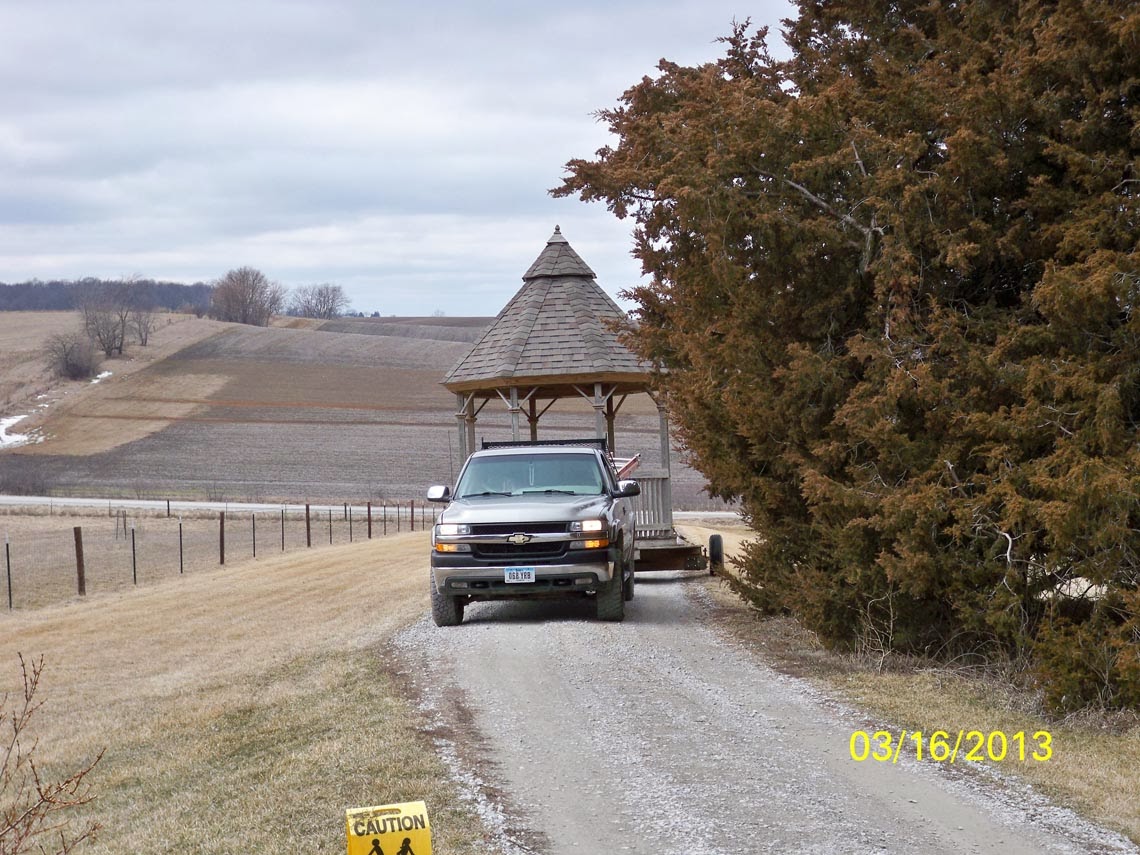
Unfortunately, most of the truckers who haul things on trailers didn't think it could be moved, because this particular gazebo has such a tall roof (non-detachable), too tall to pass under the bridges over the interstate while on a standard three-foot-tall trailer. So I finally found a young man who was willing to build a trailer of sorts out of lumber and very small wheels, and tow it along 60 miles of back roads to my house, which took nearly six hours.
After six hours of slow towing on soft back roads, my Dream Gazebo finally approaches!
(Note the very low clearance under the jury-rigged trailer.)
Because the ground was so soft that day, he had to park it on our driveway for several weeks until a hard frost allowed him to tow it across the surrounding fields to its intended spot on the south end of our property. Then I paid a foundation guy to level the site, put down gravel, seat it precisely so it lined up with our pond, and anchor it into the ground with treated lumber (it can be very windy there, on the top of a hill outside our windbreaks). 

We were finally able to paint it white (with the interior of the roof sky blue) in late July, although I still need to scrub and paint the deck gray. (Next spring as soon as weather permits.) I rented a manual sod cutter and removed the grass around the sides so I can plant a few things around the gazebo, which I will also do next spring. It really looks pretty nice, our shining white gazebo on a hill. Even better than my Imaginary Gazebo.

I still need to paint the deck, but isn't it pretty with its new coat of white paint?

Perfectly aligned.

 I will cover the two other main garden improvements of 2013, and perhaps a few minor improvements, in my next post(s). Thanks for reading!

Monday, December 2, 2013

Garden Photo of the Day: Abbotsford House and Gardens

A Fairy-Tale Setting for a Beautiful Walled Garden
(Great British Gardens via Facebook)
Abbotsford House, in Melrose, Scotland, was the home of Sir Walter Scott (1771-1832), one of the world's most well-known authors, who wrote "Ivanhoe," "Rob Roy" and "Lady of the Lake." The house and gardens are today run by The Abbotsford Trust, which is attempting to restore the house and make the estate self sustaining. This is an incredibly beautiful photo.