Monday, October 13, 2014

Booksale Fever! New & Old Garden Books for Winter Reading

My stack of 21 garden books that I found at the booksale. Good winter reading!

Last Thursday afternoon my husband and I drove to the Iowa State Fairgrounds in Des Moines (the largest and capital city of Iowa), to attend the Planned Parenthood Booksale, a twice-annual sale of used and donated books that is one of the largest used booksales in the United States. I have been attending this sale since my parents took me as a child (over 30 years of attending now), and I love buying used books, so it's one of my longtime, favorite traditions.

Waiting in line for the sale to begin, the rush inside when the doors open, then seeing the books all arranged on tables just waiting for you to peruse them: heaven! The sale has over 400,000 items (!!) and this year it had an even larger selection of garden books than usual. I always rush to the garden book tables first, and it takes me almost a hour to look through just that subject (even when I'm trying to hurry, lest someone else snag the best books). I put the ones I think I might want into a handy shopping cart that they provide for those of us whose desire for books is stronger than our arm muscles.

Since we were there from 3pm to 8pm (when my husband begged to go home), to prevent ourselves from becoming weak with hunger while book shopping we visited the concession area that purveys delicious "State Fair food" (hot dogs, walking tacos, chili, nachos, and my favorite: fresh, all-natural, squeezed-while-you-watch lemonade). Mmmm!


A photo of only a small section of the sale (from www.desmoinesbooksale.com).

I ended up with three large boxes of books this year; over 70 books in total (my husband claims I have a book-buying "problem," but he doesn't know what he's talking about...). Most of my acquisitions were children's history and science books, found for $1-$2 apiece, that I use for homeschooling my two children, but I also found 21 garden books, for less than $5 each on average (some of the older books were only $2, and a few of the newest ones in nice condition were $7 or $8).


All 70 or so books that I found. Most are children's history and science books, but garden books were also well-represented in the haul.

I already have a large collection of garden books (at least 500), but I can always use more to stave off the winter blues, increase my gardening knowledge and help me plan and improve my gardens. (Plus, I just love looking at beautiful photographs of glorious gardens!)

My garden book collection is divided into a number of sub-subjects: Garden Design, Garden History, Books About Specific Flowers/Plants, Books Portraying Specific Gardens, English Gardening, and miscellaneous other garden subjects. I was able to find quite a few very interesting books in most of these subjects on Thursday:

Garden History Books

My latest acquisitions in garden history books and historically significant garden books.
I have a great interest in garden history (and I'm currently thinking about writing a book about Iowa garden history), so I'm always on the lookout for interesting and beautiful books about that subject. Ten of the 21 books I found at the sale are either books about the history of gardening or classic gardening books that are now a part of garden history in themselves:

  • A Brief History of Gardening is a world overview of significant advances and trends in gardening, from Ancient Mesopotamia until the end of the 20th century.
  • Colour Schemes for the Flower Garden by Gertrude Jekyll was written by the great Arts & Crafts English gardener and published in 1908. Each winter I try to read one or two classic garden books, and I think this will be one that I read this winter. 
  • Garden People is a fascinating book of photos of English gardeners taken by Valerie Finnis from the 1950s through the 1970s.
  • The Gardens of Ellen Biddle Shipman describes the career and designs of noted landscape architect Ellen Biddle Shipman (1869-1950), including her well known designs for Stan Hywet, Longue Vue, and Duke University's Sarah P. Duke Gardens. 
  • The American Lawn is a collection of essays about the history and meaning of lawns in the United States - an important topic in the history of gardens.
  • Garden Shrubs and their Histories was first published in 1963 and tells the stories of the discovery and cultivation of numerous garden plants and shrubs. This edition is updated by the addition of more than a hundred beautiful full-color botanical illustrations from the 18th and 19th centuries.
  • Outside the Bungalow describes the types of planting that are historically appropriate for Arts & Crafts and 1920s-era bungalow houses, and is filled with lovely photos of well-maintained historical houses and their gardens.
  • Gardens are for People was originally published in 1955 by noted American landscape architect Thomas Church and is a well-known classic text that describes the then-revolutionary idea that yards should be designed specifically for the use of the people living in a house. Filled with photos of midcentury garden designs, it is required reading for most landscape students.
  • America's Gardens was published in 1964 by Better Homes and Gardens, and is filled with vintage color photos of some of the most well-known garden in the US.  

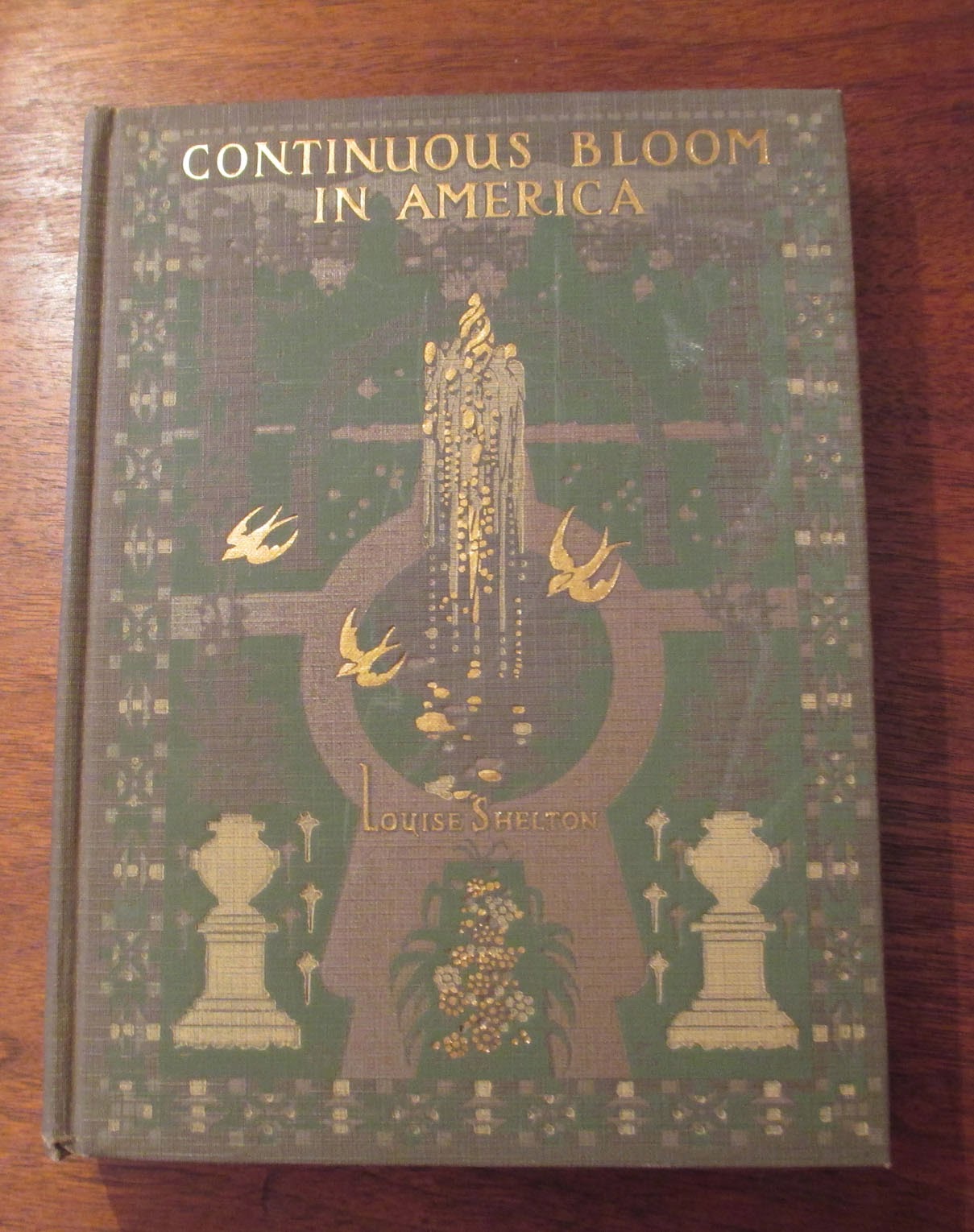
The most interesting garden history book I found was the oldest: "Continuous Bloom in America" by Louise Shelton (the link will take you to an epub you can read entirely, because the book is out of copyright). First published in 1915, my copy is a reprint from 1926, and is in very good shape (the pages are still uncut, so it has never been read). Not bad for $3.

The frontispiece photo, showing "Cherrycroft" in Morristown, NJ.
I absolutely love old garden photos!

Books About Specific Plants

The books I found about growing specific plants or types of plants.

I also found a number of books that cover how to grow specific plants or categories of plants. Last spring, when I was designing my island shrub beds, I checked Adrian Bloom's "Gardening with Conifers" out of my local public library, so I already know that it's one of the best books on the subject and one that has received much public praise, and I was happy to snag a nice copy for $5. I'm also looking forward to learning more about growing coleus, scented indoor plants, early bulbs (so nice to see after winter!) and irises. And Tracy Disabato-Aust's book, 50 High-Impact, Low-Care Garden Plants, is one I plan to study carefully over the winter. Lastly, who doesn't love Old-Fashioned Flowers?


Miscellaneous Garden Subjects

A few miscellaneous books in different subjects.

The last four books I found the other evening were miscellaneous in their sub-subjects:

  • Everything You Can Do in the Garden Without Actually Gardening is not actually about gardening but instead is an amusing historical look at how people have used their gardens. I can't describe it any better than this review at Amazon.uk:  "Richly illustrated and packed with extracts from letters, diaries and novels, EYCDITGWAG looks at gardens as places for escape and inspiration, fresh air and exercise, fire and water, sun and shade, eating, drinking and smoking, love, children, games, parties, birds and beasts - such as the bizarre menagerie that Dante Gabriel Rossetti maintained in his back garden, which included two wombats, a marmot and an armadillo. And if that's not more interesting than when to plant your onions, I don't know what is."
  • The Royal Mile is a small book describing a mile-long garden made for the Garden and Landscape Architecture Triennial in Apeldoorn, the Netherlands, which took place in 2008.
  • Williamsburg's Glorious Gardens (you can actually see all the glory at this link) is what I like to refer to as pure eye candy for the gardener. Looking at these beautiful colorful photos, heavy on spring and early summer blooms, will sustain my spirits in February and March, when I'm yearning for signs of spring.
  • Colorful Gardens is an addition to my collection of books about different flower colors (shown below), which I became interested in when I was designing my Rainbow Border. 

My bookshelf of garden books about different colored flowers. Some are entire books about one color of flowers, but others cover all the colors by chapter.

I do want to note an interesting point about the books that I bought at the booksale: eight of them were discards from the Des Moines Botanical Center's library. The Botanical Center has been retrenching over the past year after serious financial difficulties and has recently reopened to much fanfare, with new horticultural staff and new gardens in process. I have yet to visit, but I'll make a point of doing so next year. I wish them much luck with their exciting changes, and I'm glad they will not be closing (my husband and I were married there in 1998, so the place has special meaning to me). I understand that they probably needed to let go of things that occupy space (like their library) that will be needed for new purposes, and I'm happy that I was able to buy some of the books they donated to the sale.

I hope you too find many good garden books to tide yourselves over for the winter. Thanks for reading! -Beth

Tuesday, October 7, 2014

Autumn's Surprise Posy


I was walking around my Pond Gardens yesterday and happened to see that my dianthus 'Sweetness' are blooming again, despite the fact that they are an early summer-blooming perennial:

A few tiny blooms can be seen on the dianthus edging the four L-shaped gardens beds around my pond. (They're easier to see close-up. Note: the left bench blew over in one of the windy storms we had a few days ago.) The phlox 'Bright Eyes' are about done too, although I'm happy that they still have a few flowers on them, since they've been blooming since late June!

Here's what the dianthus looked like at their peak in early June, with 'Prairie Breeze' Buck roses (I grew the 200 or so dianthus from seed in 2012 and they are still going strong, despite my clay soil):

June 2014. What a lovely time of year!

A closeup of June's magnificence.


Anyway, I was quite delighted to find even a fraction of their earlier blooms repeating this late in the year, and the fragrance is still every bit as delicious as it was before. So I picked a selection from the mixed variety and brought them inside for a miniature posy bouquet (it's only about 3" tall in the vase). The spicy-sweet scent is just the thing I need at this time of year.

Another view from a different side, showing all the different
beautiful colors and shapes of the flowers in the mix.

This is time to enjoy the late flowers in our gardens. You never know what might surprise you by blooming when you least expect it.

Thanks for reading! -Beth

Saturday, October 4, 2014

An Autumn Scene


This sugar maple tree at the southwest edge of our property was so beautiful the other day that I had to take a few snapshots of it. The colors were nearly at their peak, and rain and wind hadn't yet ripped off the leaves and mashed them into a wet mush on the ground (which usually happens right when the leaves are looking their finest in the Midwest).


I installed the tree bench several years ago, and it's a lovely spot to sit and look out across the fields (planted this year in soybeans, which are turning yellow at harvest time). It's an especially nice vantage point from which to watch the sun set in the west. In the summer, the leaves provide cool shade at midday, and in the fall, it's a warm place to sit in late afternoon, while munching on an apple from the nearby apple tree.


It's unfortunate that such scenes are so fleeting, but like flowers, summertime and youth, they can be breathtakingly beautiful while they last, and lovely to hold in your mind after they are gone. I hope you're able to enjoy your own autumn scenes where you live.

Thanks for reading! -Beth

Thursday, October 2, 2014

Harvesting the Basil for Delicious Pesto

One of our basil patches, in a photo from a month ago.

I finally finished harvesting some basil to freeze for use over the winter. A packet of basil seeds can yield more than you know what to do with in August and September, but there's nothing like enjoying pesto in January, when fresh basil costs $4.00 for a few leaves. Frost is around the corner, so it's time to harvest some to put by for colder days.

I picked the leaves over two evenings. The first time was about an hour before sunset, and I was stung on my finger by a bumblebee that had secreted itself under a leaf (ow!). I leave the flowers on just for the bees, so I can't blame them, but it still hurt. So the next evening, I waited until after it was dark to cut a large shrub at the base and brought it to my front steps to pick the leaves off by the front porch light. That was almost worse, as a number of disgusting slugs had taken up residence on the underside of some of the leaves because night had fallen. I didn't even know I had slugs here, but the ones I saw were quite small, and haven't caused damage to my hostas, so I guess I should consider myself lucky after hearing about what our British garden blog friends have to deal with. But the slugs were still gross to encounter with my fingers. (Bleagh!)

Anyway, I picked (with some help from my husband and two children), two 5-gallon buckets of leaves, and brought them inside, where I washed them in my salad spinner. (I washed and spun them several times, in case any slugs escaped my notice -- yuck!)


Washing the leaves.

Then I got out my extra-large food processor (that I use only for large tasks such as this) and used it to chop up the leaves, adding plenty of olive oil.


This is my largest mixing bowl, so I ended up with quite a
generous amount.

I used a 1/2 cup measuring cup to measure it out into snack-size
Ziplock bags, and sealed them up (I apologize for the blurry photo;
it's hard to take a photo with one oily hand!)

I ended up with 22 Ziplock bags full.

Then, I sealed the snack bags in a large freezer bag.

Why do I do all this? For only one reason: making pesto, one of Italian cooking's most wonderful classic summer dishes.

The recipe I use for pesto is one from the venerable Marcella Hazan's "The Classic Italian Cookbook," and it is truly excellent. I give the jist of it below:

Blender Pesto

2 cups fresh basil leaves
1/2 cup olive oil
2 tablespoons pine nuts (I crush them in a mortar)
2 cloves garlic (I use a garlic press to mince them, and use 2 if they're small cloves, only 1 if they are larger)
1 teaspoon salt (or perhaps a bit less, I would taste it first before adding all of this)
1/2 cup freshly grated Parmesan cheese
2 tablespoons freshly grated Romano pecorino cheese
3 tablespoons butter, softened to room temperature

1. Blend the first five ingredients in a food processor (unless you're using pre-processed basil from the freezer, as I do; in that case, just mix all the ingredients together by hand in a bowl and decrease the amount of olive oil, since the basil is already frozen in oil)
2. Pour into a bowl (if you used the food processor for step 1) and mix in the two cheeses, then beat in the softened butter
3. Serve over pasta. (I like to make this dish with grilled sweet Italian sausages and tomatoes fresh from garden drizzled with olive oil, salt and a few chopped basil leaves.)

I usually don't even measure the ingredients at all, because I don't think you can mess up this recipe -- all these ingredients taste delicious together, no matter what! I do think I might usually add more cheese than the recipe calls for, and add less salt because of that. But I think the addition of the softened butter really enhances the taste, making it richer than many pesto recipes, so be sure to include it.

I can't wait to enjoy this summeriest of foods when it's below zero. Actually, thinking about it is making me crave some pesto right now, so perhaps I'll have to go out and pick a few more leaves for pesto tonight.

Thanks for reading! -Beth

Sunday, September 28, 2014

The Kitchen Garden: 2014

I haven't posted much this summer about our Kitchen Garden. It's largely my husband's domain, although I designed and laid out the garden, and I help him by starting seeds occasionally, replenishing the mulch in the paths and the compost in the beds, plus other random tasks. But I confess that I'm usually so much more enchanted with the state of my flowers in bloom that I've largely neglected to post photos of the vegetables that we've grown.

Here are a few photos of our vegetable bounty from the last month or two:


A photo from back in July of the "greens" section of the Kitchen Garden: onions, celery, cabbage, chard, Brussels sprouts and carrots in the center.


Okra in August. This usually grows pretty well for us (and it's delicious pan-fried in oil with onions and curry powder), but this year we allowed it to be shaded out by the numerous self-seeded sunflowers that grew up around the okra plants (so pretty!), and unfortunately the plants didn't bear much. We'll know better next year: Okra like sunshine!

Pumpkins and watermelons last month.

Potatoes harvested in late August.

When we pulled out the superfluous sunflowers, we found this hoard of old cucumbers that my son had grown and left in a pile, which we thought was funny.

Eggplant.

Some beautiful tomatoes.

The peppers did very well this year too.

Pumpkins against a backdrop of sweet corn gone over. We'll let the corn stalks stand
over winter to provide some windbreak for the chicken pen behind (to the south).

Winter squash.

Rainbow-colored chard. Quite pretty, I think.


A photo of the overall layout of the Kitchen Garden, taken in July. The front two rows (eight beds) are for cutting flowers (my domain), although I believe that I'm going to downsize next spring, using only the first four beds on the left. I just don't need that many flowers, and I know I can grow them more efficiently (and with less work) in half the space. I'll have fun over winter re-designing these beds on paper and deciding which flowers I like best for cutting.


My husband and I are still learning much about vegetable growing, and we make mistakes all the time. But I believe that we're becoming more knowledgeable each year, and the Kitchen Garden improves each season.

Thanks for reading! -Beth

Monday, September 22, 2014

September in the Rainbow Border

The Rainbow Border, as seen from the end of the rainbow progression of colors. The effect can clearly be seen, which is encouraging, as that's what I've working toward.

My Rainbow Border is in Year Three (I planted most of the perennials in 2012), and it's starting to look a bit more filled in this year. Most of the perennials bloom in May and June: tulips, irises, Asiatic lilies, peonies, alliums and the like, but from July on, the color is carried by annuals: mostly zinnias, petunias and marigolds.

But I've been thinking that I should add some tall garden phlox toward the back of the border. Phlox is long-blooming, blooms later in the summer and is available in a number of colors:
  1. White: the two White Sections of the border seem particularly sparse and could certainly benefit from an expansive perennial like phlox), and 'David' does well in other areas of my garden
  2. Pink: phlox comes in both dark and light pinks, and more purplish as well as more salmonish pinks
  3. Red: I'm not sure if the reds are crimson/purple reds, or more like scarlet/orange reds -- I would want to see the plants in bloom before I could know where in the Red Section to plant a flower
  4. Orange: but the orange might look more pinkish salmon in color and not fit in with my true oranges in the Orange Section
  5. Green-ish: I've seen a "Green Expectations" phlox that is white with green petal tips, which I might order next spring to give it a try
  6. Blue-ish: 'Blue Paradise' and 'Blue Boy' both look like they could be pretty close to blue in color, at least in photos online
  7. Purple: I have plenty of this in my gardens already that I could easily transplant
In fact, phlox seems to be available in pretty much any color but yellow (although there might be a yellowish annual phlox that is shorter in height). But there are plenty of other yellow-flowering perennials that I could plant instead in the Yellow Section.

Next spring (how I already love the sound of that phrase!), I will add some phlox to see if it helps the rainbow effect look more pronounced in late summer. 


Seen from the other end: white, pink, red, orange, yellow, green, blue, purple and back to white again at the far end.

Here are photos of each color section of the border:

The first White Section could seriously use some white phlox about now. The ox-eye daisies have taken over and not allowed the white cosmos to fill in as I wanted, and sadly, not much else is going on here. 

The Pink Section is a bit better, with roses, a mum, petunias and a single zinnia in bloom.

The Red Section could be worse, but I think I will try to move things around and add some plants next year to add some more color in this section.

I wish there were more orange flowers that weren't marigolds, but I suppose I should be happy that they grow so well in this spot. The California poppies that took over this section earlier in the summer seem to have waned, but the Zinnias look pretty nice, in my opinion.

The Yellow Section seems to do pretty well from late spring until fall. There are so many yellow-flowering plants that love full sun, that this section rarely wants for color.

The green zinnias and Bells of Ireland are going strong. I love green flowers!

The 'Victoria Blue' salvia is looking great in the Blue Section, with a few leftover delphiniums in back and bachelor buttons in front.

The Purple and ending White Section (with reblooming white iris). Some tall garden phlox certainly wouldn't go amiss in these sections. I'll definitely plant some here next spring.

That's it for the Rainbow Border, which I will continue to work on improving each year. Thanks for reading my progress report!  -Beth

Sunday, September 14, 2014

The flowers just keep going....

I immediately identified with Casa Mariposa as she remarked in her latest blog post that she always feels surprised that her gardens continue to bloom this late in the year, even though she planted everything herself and should, of course, know what's in her own gardens. I feel exactly the same way. Even though we've had some chilly nights (and a couple days that were 25 degrees below the average temps for this time of year), my gardens continue to surprise me with many flowers:

My delphiniums have re-bloomed for the first time this year, and although this secondary flush is shorter in height than the June flowers, that means they are easier to stake than the earlier ones (nice for the lazy gardener!).


This combination of aster, mum and annuals at the corner of the border around our house addition is a study in bold colors, with orange, purples, blues and dark reddish-pink. I think I like these colors together.
These low purple asters edging my Front Border are
a lovely mix of light and darker shades.

The cosmos and zinnias are still a riot in the North Border. I want this show to go on forever.

These perennial sunflowers, helianthus 'Lemon Queen,' are just right for the sunny south side of our garage.
This is just three plants -- they like to fill in (and up).
The Yellow Garden is filling in quite nicely for being less than six months old. The yellow butterfly bush (the tallest thing on the right side of the stepping stones) is very close to blooming. I will make sure I get some photos of it when it does, as I've never had luck overwintering them here in Iowa. We'll try again this year.
The four o'clocks are in full swing here in the Peony & Rose bed. I planted these because I read that they are poisonous to Japanese beetles and I did notice that a few weeks ago when I saw the beetles, the roses not surrounded by four o'clocks were attacked, but the roses surrounded by them were mostly left alone. Wow, one of my ideas might actually have worked! I'll test my theory again next year.

A pretty pink 'Clara Curtis' mum in the North Border.

Dahlias and zinnias in the Cutting Garden. These pink dahlias might be the nicest I've ever grown.
I will definitely try to save these over the winter.

I switched out my pansies for yellow mums, marking the change from
summer to autumn. Window boxes are always so cheery, don't you think?

I'm so glad we (might) have at least another month or so to enjoy these late flowers. I still have mums that haven't quite bloomed yet, so I'll have even more to look forward to, and I'll try to post photos of them when they are at their peak autumn glory (there's a particularly impressive orange one that I refer to as being "hu-mum-gous" that never fails to knock me out with its size and color).

I'm just starting classes for my county's Master Gardener program, so I'll be busy this fall, but I hope to learn a lot of interesting things that will not only help me make my own gardens more beautiful, but also allow me to get involved in helping others make their own gardens more beautiful and productive. I'll try to occasionally post about what I'm learning as I go through the program. Wish me luck!

To a late and warm winter -- and thanks for reading! -Beth