Showing posts with label Garden Visits. Show all posts

Saturday, May 22, 2021

My Visit to a Beautiful Garden of Saunders Peonies


Greetings! Last weekend my husband, children and I visited my mother in Ames, Iowa, seeing her for the first time in nearly a year and a half. Now that she and most of my family have been fully vaccinated, she was eager to see us again after such a lonely Covid year spent completely by herself. It was so wonderful to finally see her in person again.

While in Ames, I wanted to visit a peony collector there whom I've been corresponding with via email for the past few months, and I thought that my mother, a retired botanist, might also enjoy a visit to a beautiful garden owned by a fellow retired scientist.

Lois Girton is writing a book about the peonies hybridized by A. P. Saunders (1869-1953), a professor of chemistry at Hamilton College in upstate New York. Today he is regarded as the most prolific peony hybridizer of the 20th century and "the father of the modern hybrid peony."

A.P. Saunders
Here's an article about him and his hybridizing efforts:
https://www.peonysociety.eu/saunders-peonies/

And this is Lois' own website in which she has photos and information about each of the hybrids she has either been able to grow in her own garden or has photographed in other gardens:
https://www.saunderspeonies.com/

Lois has collected probably at least 170 Saunders peonies, out of the approximately 270-300 that may exist. (I can't imagine how expensive it must have been to buy some of the rarer cultivars.) And Lois also has many other herbaceous, Itoh and tree peonies -- a collection of 400 peonies in all!

My mother and I (and my husband) were able to enjoy some of the extraordinary beauty of her collection when we visited her gardens last Saturday, as many of the tree peonies were in full bloom. This is certainly a good time to visit a peony garden!

Here's a few photos of her gardens (unfortunately it rained before I was able to take these photos, so most of the peonies are closed -- but still beautiful covered in raindrops):


Here's the front of Lois' beautiful 1940s farmhouse. You can see her lovely peonies and conifers.


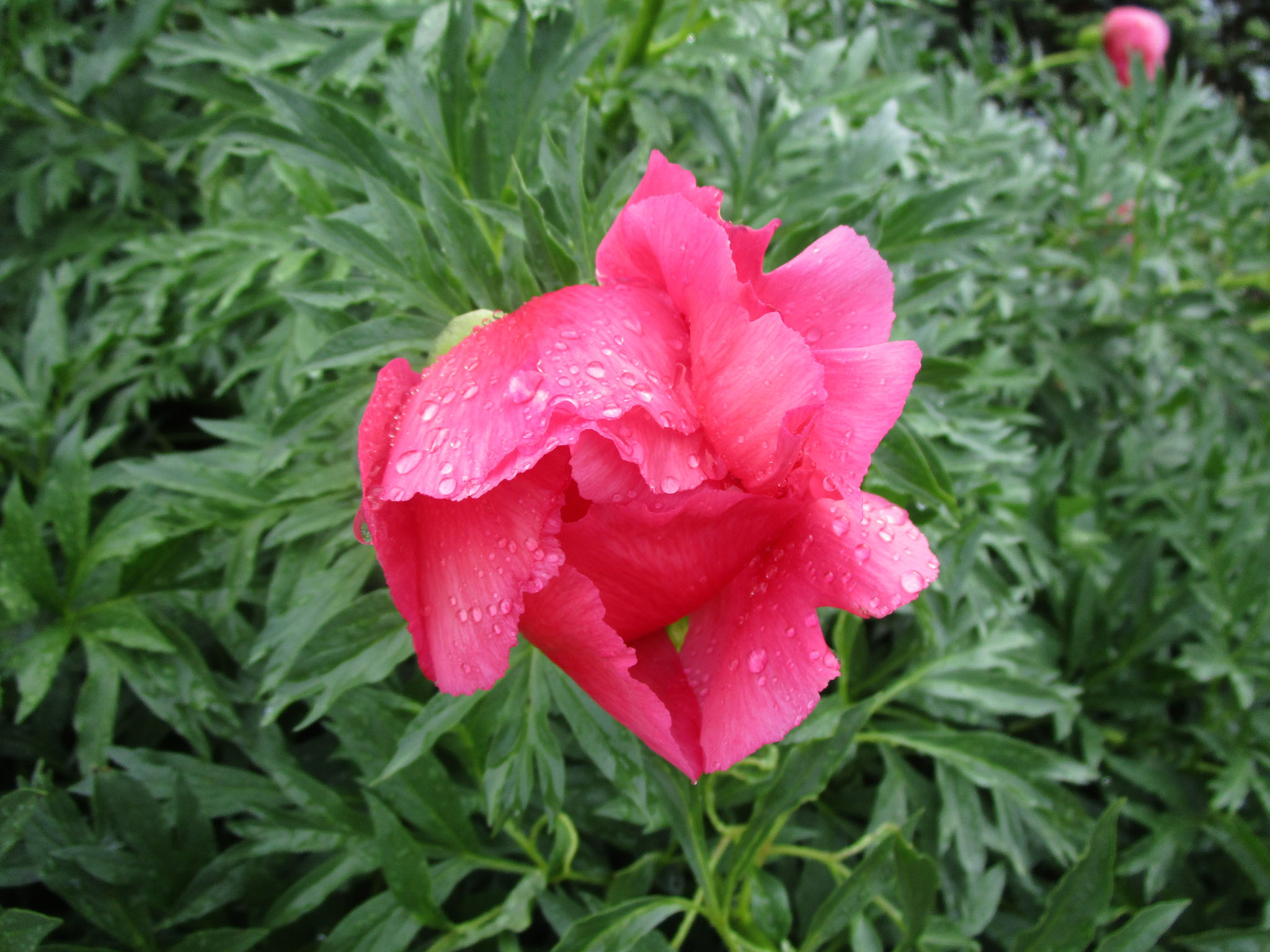
Here's a closeup of the peony in the distance in the last photo. Lois told me that this beautiful cultivar is 'Pink Tea Cup' (not a Saunders cultivar, but very pretty nevertheless).


Coming around the house in her large front yard -- her property is more than an acre in size, which is unusual in the middle of a college town. Here's an island bed filled with Saunders peonies.


This is a Saunders peony: 'Montezuma' (1943). It's actually a more red color than this in real life, but reds are often difficult to capture in photos.

I knew that plant was 'Montezuma' because of the professional-grade plant labels Lois has put next to all her Saunders peonies. Very impressive. Lois' garden was one of the gardens toured during the American Peony Society's last convention in 2019, held at the Reiman Gardens in Ames (she gave a talk about Saunders peonies at the convention). 


Turning around to the back yard, this beautiful magnolia frames the view of a formal garden area behind Lois' house.


A white fence encloses the formal area...


...which contains long rectangular peony display beds, with other plants like alliums to set off the beautiful peonies.


Directly behind Lois' house, a path leads to a patio and more garden areas. I honestly don't know how she manages to maintain all these beautiful areas so neatly.


And on the back of her house, you can see the wonderful sunroom that she built to enjoy the views of her gardens in wintertime.

Lois very generously made us a lovely tea, which the four of us enjoyed in her beautiful sunroom while a few rain showers fell outside. We were able to discuss her plans for her book about Saunders peonies, and her hope that she will eventually be able to donate her Saunders peony collection to the Iowa Arboretum (about 15 miles southwest of Ames), for which Lois served as a board member for several decades. 

It was great to meet Lois in person after corresponding by email, and I wish her good luck in finishing and publishing her book, which is certainly an impressive project.

And a big thank you to Lois for such an enjoyable visit to her beautiful gardens! I think my mother really appreciated getting out of her house and seeing so many expertly grown plants in a garden she has driven past many times but never been able to enjoy up close. And I loved being able to spend time with my mom in such a beautiful setting, seeing her again after so long.

Thanks for reading! -Beth


My mother.


Saturday, July 20, 2019

My English garden visits


Greetings! Last month my family and I spent 2&1/2 weeks in England, and I thought I'd share a few moments from the beautiful English gardens I visited while there.

My trip wasn't all gardens: we traveled with another family we know, and it rained nearly every day we were there (apparently, it was the wettest June on record, with flooding in parts of the country). Both factors meant that I wasn't able to see every garden that I wanted to. But I did manage to make it to some of the most well-known of England's famous gardens.

Please forgive the length of this post, as I'd like to simply share a few photos from each garden in this one post and not write a series of more detailed posts over multiple weeks.

Sissinghurst

My family flew to London two days before the other family we traveled with, so that we could spend a couple days in Kent before returning to London to meet up with them. We took a train to Maidstone, where we rented a car and drove south to the tiny village of Sissinghurst, where we stayed in an ancient cottage listed on Airbnb.

Driving on the WRONG side of the road was terrifying -- my husband did the driving, but we were all terrified, all the time. And the cottage was picturesque, although the doorways were so low that my poor husband still has scars on his scalp. But it was a great adventure to spend time there, and that's how we were able to visit the first of the gardens on my list (shown in the first photo), the most famous of England's countless gardens, Sissinghurst Castle & Gardens. 

Here I am standing in the Rondel, the round space shown in the first
photo. The iconic Sissinghurst tower is in the background.

I've read about Sissinghurst and Vita Sackville-West for nearly two decades now, and it was wonderful to finally set foot in this most famous of gardens. This first day of our trip (June 6, my husband's and my 21st anniversary!) was the sunniest, warmest day of our entire two-and-a-half weeks in England, which made our visit to Sissinghurst truly lovely (although it was difficult to get good photos in the bright sunshine).

The rose gardens were at their peak and were the most beautiful flower gardens I've ever seen.

A small corner of the incredibly lush rose gardens.
My pictures don't do the rose gardens justice -- every ancient brick wall was covered with climbing roses heavy with bloom; every bed was stuffed full of roses, peonies, delphiniums and other perennials in flower. 

Here I am in a corner of the famous White Garden.


Sissinghurst wasn't as crowded as I had feared it would be on such a beautiful day. There was a coachload
of German tourists and many other visitors, but most had left by mid-afternoon, and by four o'clock, we had
the entire garden nearly to ourselves. It was a magical day, the nicest anniversary we've ever had.


Great Dixter

Because England's 2nd-most famous garden is only 20 miles from Sissinghurst, I couldn't pass up the opportunity to visit Great Dixter while down in Kent. Unfortunately, it rained heavily for nearly our entire visit there, so I didn't enjoy my visit there nearly as much, or appreciate the design and planting of the garden areas as much as I might have, had they been less sodden.


Here I am after the rain briefly stopped, in front of Christopher Lloyd's medieval house (now a museum), with the collection of potted plants that this doorway area is known for.

Rain on the pond in the Sunk Garden, designed by Lloyd's father in 1921.
The Long Border, 330 feet long and 15 feet deep: succession planting on a heroic scale.

Royal Botanic Gardens, Kew

After returning to London, we met up with our friends at our hotel in the Bloomsbury area of the city and did some sightseeing for the next five days. My husband and I skipped the Tower of London and instead hopped on a train to Kew Gardens, and enjoyed the afternoon's excursion to one of England's largest gardens (330 acres of gardens, glasshouses, and a research herbarium that houses the "largest and most diverse botanical and mycological collections in the world"). We couldn't see all 330 acres, but were able to take in most of the highlights of the gardens. Several of those:

In front of the magnificent Palm House, built in the 1840s.


The interior of the Palm House is filled with exotic plants.
Behind the Palm House, the rose garden was in full bloom.
My husband was dwarfed beneath this colossal chestnut-leaved oak. Planted in 1846 by Kew's
first Director, Sir William Hooker, from an acorn collected from the Caucasus region, it stands
over 120 feet tall and is the largest of this species in the British Isles. Kew's arboretum areas
are among the most magnificent in the world.

Regent's Park

My family had a good time at Winston Churchill's war bunker, but since I don't like crowded or underground places, I spent that morning stopping by the Sherlock Holmes Museum on Baker Street, and then walking next door to Regent's Park. I had no idea what the park would be like -- and I found that it's 400 acres of the usual lawns and trees, with Queen Mary's Garden (opened in 1935) at its center. I quite enjoyed walking through the parkland and gardens.

Beautifully landscaped municipal park settings....

Families enjoying the lovely morning....
But then I stumbled on this.
The English sure don't do roses on any sort of small scale, do they? The huge, be-swagged, Rose Garden apparently holds London's largest collection of roses -- 12,000 of them, planted in 85 single-variety beds. And that's in addition to the other 18,000 roses planted in other parts of Queen Mary's Garden. And they were nearly all in full bloom when I stumbled on this display. I had no idea that Regent's Park is famous for its roses, so this really was quite a surprise to come upon so unexpectedly. A wonderful surprise!


Thornbury Castle Gardens

After London, we traveled by train to Oxford, then rented a car and drove south to Bath, then west to stay for two nights in Thornbury Castle (now a hotel) near Bristol. The Castle has beautiful gardens -- perhaps not commensurate with National Trust-level gardens, but lovely nonetheless -- and we had the gardens nearly to ourselves, which I think greatly adds to the enjoyment of a garden.

The tower of Thornbury Castle (built in the early 1500s) can be glimpsed beyond this part of the garden, and the ancient walls enclose the entire garden. (I don't think geraniums look this blue in the Midwest -- I don't know if it's the different quality of the light or the moist conditions, but they never look this vibrant in my gardens.)
A bee hive set into one of the ancient garden walls and surrounded by lovely roses.
Matilda, the Castle cat, liked to follow us around to keep an eye on us.

We really enjoyed our stay at Thornbury Castle.


Hidcote

After leaving Thornbury, we drove east to the Cotswolds area, and stayed at an Airbnb in the small village of Bourton-on-the-Hill. I wasn't sure if I'd get a chance to visit Hidcote Gardens, despite staying only 20 minutes away from England's #3-most-famous garden (no accident, that!). But the weather looked to be nice enough, and one morning my husband suggested that the two us drive there while the rest of our traveling companions slept in. I'm so glad we did!

The White Garden at Hidcote.
The famous Red Borders.
Hidcote's Long Borders. Stunningly lovely!
My husband in the area named "Mrs. Winthrop's Garden" by garden creator Lawrence Johnston for his mother.

Hidcote felt like the largest of all the gardens I visited, despite being only 10 acres in size -- but they are 10 mostly intensely-gardened areas and garden rooms, more than 30 in all. The gardens just went on and on, and we actually didn't have time to see all the areas. (It made me tired just thinking about maintaining it all!) But each room was an incredibly beautiful garden in itself, and the whole constitutes a truly great work of art. After Sissinghurst, this was my favorite English garden.

A Few Other Gardens

Being a garden-lover, and in England, I managed to find many other garden spots to enjoy while there, but this blog post is long enough already, so here are just a few last highlights:

Bourton House Garden was literally two blocks away from our Cotswolds cottage, so we all walked over on the last morning before our trip back to London to fly home. It was a wonderful garden, a hidden gem filled with topiary, garden rooms, exotic plants and a high outlook over the Cotswolds. Very enjoyable.

Chastleton House is a fascinating country house that was built in the early 1600s, which successive owners never had the money to completely remodel or update, so, unusually, most of the rooms still reflect their original design. In 1991 it was given to the National Trust, which made the controversial decision to leave it in pretty much "as-is" condition, reflecting how people lived in it during the 19th and 20th centuries. The gardens, however, have recently been restored to their 1830s layout and 1920s planting design (while the topiary in the area above is at least a century old, the flower beds had been turfed over in the mid-20th century, and were only re-planted in the concentric beds this spring).
The transportation center in Bath had this imaginative display...

...as well as this jasmine-woven wicker chair. Heavenly!
Finally, this garden is actually a one-ninth-scale replica of the tourist village of Bourton-on-the-Water (not to be confused with the village where we stayed, Bourton-on-the-Hill). We were excited to see a model village after watching the movie "Hot Fuzz," in which a model village featured prominently in the film's sinister village. (This model village wasn't sinister at all, and was actually pretty fun to see!)

My family and I had a good time seeing places in England that we've been reading about or watching on television. As a garden enthusiast, I was so happy to finally visit a few lovely English gardens, and despite the rain, I greatly enjoyed every garden I saw.

But it's good to be back home (and the weeds certainly didn't wait for me!). It seemed strange that it was almost July already and 90°F, when it was barely June and rainy when we left. Since it was rainy with temperatures in the 60s most of the time we were in England, I've only slowly become acclimated to our Midwestern heat (hot & windy, with temps near 100°F this weekend!)

I've been incredibly busy since our return getting ready for last weekend's Open Gardens Weekend, a new event for our local public beautification charity, Project GREEN. My garden wasn't open, but I was chair of the event, and since we haven't done it this way before (any garden can open, and attending the event is free, sponsored by local businesses), we're still figuring things out. But now that it's over for this year, I can relax a bit and rest up from traveling and everything else.

It's truly good to be back home, and I hope you've enjoyed seeing a few of the gardens I was lucky enough to visit in England. Thanks for reading! -Beth
Thursday, April 7, 2016

Early April Scenes


No, that's not my garden above (!), but a beautiful scene from the Missouri Botanical Garden in St. Louis, where my family and I were lucky enough to visit last weekend, on a beautiful, warm, sunny day. The flowering trees were magnificently in bloom, the bulbs were flowering their little heads off, and everything was lushly green and growing.

St. Louis, about 250 miles south of us here in Iowa, is usually about two weeks ahead of us each spring, and this spring is no exception, even though spring has come relatively early this year in both locations. It was nice to see a preview of the flowers that will soon be blooming here (if not in such impressive quantities as in the MOBOT).


A scene from the MOBOT bulb garden. This was just one tiny corner of a huge area filled with
massive beds of flowering bulbs, spring perennials and annuals. It was lovely.

I have visited the MOBOT every spring (and at other times of the year too) for more than five years now, and every time I take away one main idea. Last spring it was "More bulbs!"

This year, it was "More scented plants!". I was really entranced by the many lovely scented flowers in the gardens: lilacs, hyacinths, and those of the many tender plants in their Linnean House (the oldest continuously operating display greenhouse in the United States), including jasmine, fragrant olive and numerous citrus. So I made a note to myself to try to plant more scented plants in my own gardens, and perhaps I can even grow some of the tender scented plants in the sunroom that I am hoping to build this year.

But back to Iowa. Here are a few scenes from my own modest plot. Things are just starting to get going this spring:

The border in front of our library. This south-facing border warms up earlier than almost
any other part of my gardens, so last year (inspired by my MOBOT visit) I planted a number
 of early-blooming bulbs here. Crocus and iris reticulata are done flowering, and miniature 
narcissus, grape hyacinths and Single Early tulips are flowering now. 
They seem to glow in the sunshine.


A closeup of the Single Early Tulips 'Flair'. These are supposed to be 14" in height, but I think they somehow became stunted,
as they are blooming on stubby, short stems. Has this ever happened to anyone else?


Some Libanotica Puschkinia or striped squill, with a leftover blue hyacinth on my West Terrace.


A 'Royal Star' magnolia. I don't think our recent light frosts have hurt the blooms on this small shrub that I planted in 2014.


A progress report on the new iris bed that I am making as part of the Peony Border: It will contain iris, alliums, poppies and perhaps some lupines, if they will take full sun here. I'm inspired by the magnificent May displays at Schreiner's Iris Gardens in Oregon, and I hope I can bring a little of that May magic to my modest Iowa gardens. I rented a sod cutter on Monday and removed the sod, loading it into our pickup truck and unloading it in one of our compost piles (hard, dirty work, but I hope the end result will be worth it!). I just have to dig in a thick layer of leaf compost and it will be good to go, and I can begin moving in divided irises and other perennials over the season, and planting bulbs in fall.

It's been cold and windy for the past few days, so I haven't been very motivated to work outside -- if I had to, I could, but it's still early in the season, and I garden for the enjoyment of it, so why not wait until sunnier, warmer days? (I guess I embrace being a fair-weather gardener....)

Hope you are enjoying some sunnier, warmer days in your own gardens. Thanks for reading! -Beth

Sunday, June 7, 2015

Garden Visit: Bickelhaupt Arboretum


Yesterday was my husband's and my 17th anniversary, and we had a nice outing with our children to Clinton, Iowa for the day, a drive of about an hour-and-a-half from our house. Our first stop was for lunch at the Candlelight Inn restaurant, which is located right on the edge of the Mississippi River, and because the weather was ideal -- mid-70s, sunny and with a pleasant light breeze -- we greatly enjoyed eating our meal on the restaurant's large elevated deck overlooking the river.

Then we visited the Bickelhaupt Arboretum, which is now owned and managed by Clinton Community College, but was established by Bob and Frances Bickelhaupt on their 14-acre property on the edge of Clinton, starting in the 1970s. The centerpiece of the Arboretum is the Heartland Collection of Dwarf and Rare Conifers, begun in 1990, and which in 2012 was named a Reference Garden by the American Conifer Society.

The collection is truly impressive. My husband and I are thinking about planting more conifers in our gardens, and our visit was very inspiring -- the variety of shapes and colors and textures of the different trees was extraordinary. The trees were uniformly healthy and vibrant, their placement was artistically pleasing and the simplicity of the conifer-only design was very appealing.

Don't get me wrong: my love of flowers is still paramount, but it would be nice to have some areas of my gardens that look as good (or maybe even better) in winter as in the growing seasons. I have been thinking about redesigning my North Border to include some evergreen trees and shrubs for winter interest, and our visit has provided me with much inspiration to do so.

Here are some photos of some of the highlights of the Bickelhaupt Arboretum:

The best section of the Arboretum!

The beginning of the path through the conifer collection. I love how the new growth on the low shrub at left is glowing in the sun (the sign was missing from the specimen, so I don't know what it is, unfortunately).

A lovely wooden bridge through the trees.

You can see the wide variety of the conifer trees. In the background on the other side of the stream at the bottom of the property is a large area of deciduous trees, many of them impressive in size.

The bench is made from stones that were originally cut to build a local building in
the 1850s. When the building was dismantled, the stones were purchased and given to
the Arboretum. We all thought that the tree to the left (a Bruns Weeping Serbian Spruce)
looked like an Ent, the tree creatures from the Lord of the Rings.

I particularly like the the gold-colored conifers.


Two more "tree monsters" schlepping along together ('Wingle's Weeper' Norway Spruce). 

The arboretum was admirably well-maintained, with very few weeds in the neatly edged and mulched beds, and trim, orderly lawn and paths.

A closeup of the beautiful cones on a tree that disappointingly did not have a sign -- most of the plants did have signs, but a few were missing.

The other areas of the garden weren't nearly as extensive as the conifer collection, but they were still nicely planned and enjoyable to walk through. The Hosta collection labeled the cultivars, so it was useful for people who wish to add to their own collections of Hostas. I saw several I'd like to have.

The Peony Garden contains about 30 peonies, including intersectional and tree peonies, as well as the old-fashioned herbaceous kind. This was definitely the right time to visit this part of the garden.

The Butterfly Garden will not be in full bloom until later in the summer, but it was still nice to see how it was designed, as we have been thinking about adding a butterfly area to our own gardens. In the background you can see that the Arboretum was set up for a wedding later that afternoon.

I found the undulating topography along the winding creek absolutely fascinating -- sinuous and dramatic. My photo certainly doesn't do it justice.


I highly recommend a visit to the Bickelhaupt Arboretum if you are close to Iowa or traveling along the Mississippi River, especially if you have an interest in conifers. We greatly enjoyed our visit and came away full of ideas for our own gardens. The Arboretum is open every day from dawn to dusk and is free to enter.


On the way home, I saw this field of wild mustard near our house glowing in the sun and had to stop and take a photo. It was really quite magnificent, a whole field of bright gold that my camera couldn't fully capture.

I hope you are also enjoying visits to inspiring gardens -- we gardeners can easily become preoccupied with our own gardens, particularly at such a busy time of year, but it's important to see other gardens to inspire us to improve our own -- plus it's just fun to enjoy a garden without the need to weed.... Thanks for reading! -Beth